Europe · United Kingdom · London · Manchester · Edinburgh · the Cotswolds and Surrey
Wall art in the UK: hand-painted originals sized to British rooms
iHomeArt paints wall art for the UK by hand and to order: original canvases for period houses, new-build flats, offices, hotels and members' clubs from London to Edinburgh, sized to the wall they will hang on. Choose from some 1,300 designs or have one made for your room, in your own paint colours if you wish, and approve every stage from photographs before it ships.
Ordering wall art in the UK from iHomeArt
- 1 pieceMinimum order; volume pricing from 10
- Any sizePainted to the wall, oversized and multi-panel included
- About 10 daysTo paint, then 5–7 days by DHL, FedEx or UPS express to the United Kingdom
- Every stageApproved by photo or video before the next one starts
- 50 / 50Half upfront, half once you approve the final photograph
What British walls decide before you choose
- Period rooms
- 2.7–3 m ceilings in most Victorian rooms; 3–3.6 m in Georgian ones
- New-build flats
- About 2.4 m ceilings; 2.5 m minimum for new homes in London
- Chimney-breast alcoves
- Typically 600–900 mm wide
- Listed houses
- Pictures hung without nails or screws into the historic fabric
- Hotels in the pipeline
- 268 projects and 39,024 rooms, the most in Europe (Q1 2026)
The UK wall art guide, page by page
Each page answers one buying question for the UK: homes, offices, hotels, where to buy, taste and size.
- Townhouses & homesLiving room wall art for UK homes
- Offices & institutionsOffice wall art for UK headquarters, law firms, clinics and universities, sized to modern floors and listed rooms.
- Hotels & restaurantsArt for hotels and restaurants in the UK
- Where to buyWhere to buy art in the UK
- Taste & stylesWall art ideas for UK rooms
- Size guideA wall art size guide for UK homes
Print or painting: what are you buying when you buy wall art in the UK?
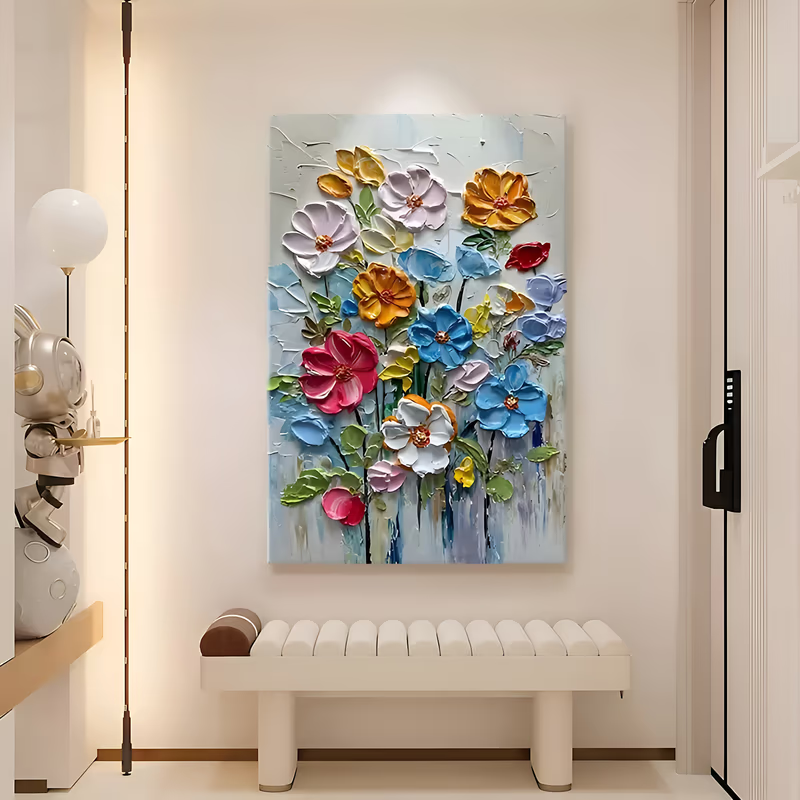
Most wall art sold in the UK is printed; a hand-painted canvas earns its place when the wall is large, the colours must belong to the room, or you want brushwork you can see in a piece no neighbour owns.
Search for wall art in the UK and most of what comes back is printed: posters, framed prints and canvas prints. That is the right buy for a rented flat, a small wall or an edition you love. Scale is where doubts begin. On a Mumsnet thread about a 'massive artwork' of about 100 × 100 cm for a living room, the poster worried that some styles would look odd enlarged, and replies pointed to originals, which one called nicer than mass-produced prints.
A painting made at 150 cm is composed at that size, so its brushwork belongs to the scale of the wall, and the ridges of a brush or palette knife catch the light. If a label says hand-painted, that side light is the test: paint throws small shadows, a print stays flat. Collectors still buy paintings first: among wealthy collectors in ten markets including the UK, paintings were the most purchased medium in 2024. Every iHomeArt canvas is painted by hand and nothing is printed; acrylic is our standard, oil is available on request, and a side-lit photograph of the texture is yours on request before you approve it. See our textured paintings.
Chimney breast, alcove or sofa wall: where does wall art go in a British home?
In a period house the chimney breast takes one square or upright canvas and the alcoves a slim pair; in a new-build flat it is usually the wall behind the sofa, which wants a long, low piece.
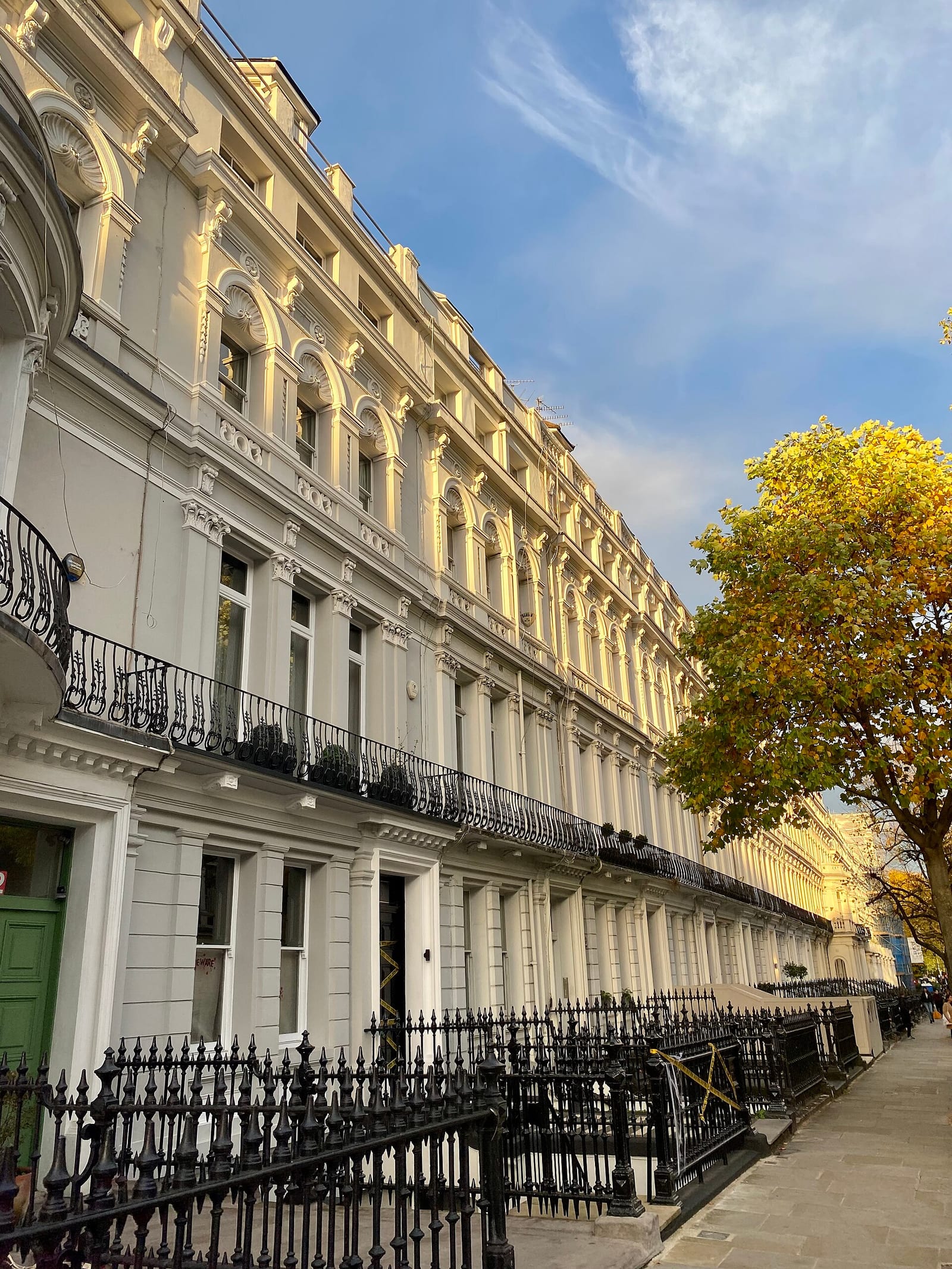
More than half of the UK homeowners who renovated in 2024 live in houses built in 1940 or earlier, so for many British buyers the first wall to dress is still the chimney breast. Most Victorian rooms stand 2.7–3 m high, and Georgian rooms 3–3.6 m, which gives the breast a tall, narrow field for a square or upright canvas a little narrower than the breast itself. The alcoves either side are typically 600–900 mm wide, so a pair there stays slim, or one piece hangs above the shelving.
New homes are lower and more open. New-build ceilings are about 2.4 m, with 2.5 m the minimum for new homes in London, and in towers the glazing takes much of the wall: one Battersea Power Station penthouse pairs 2.73 m ceilings with full-height windows. There the wall behind the sofa or the bed is the one that counts. Room-by-room sizes, in centimetres and inches, are in the UK size guide, and whole houses in British townhouses and homes.
-
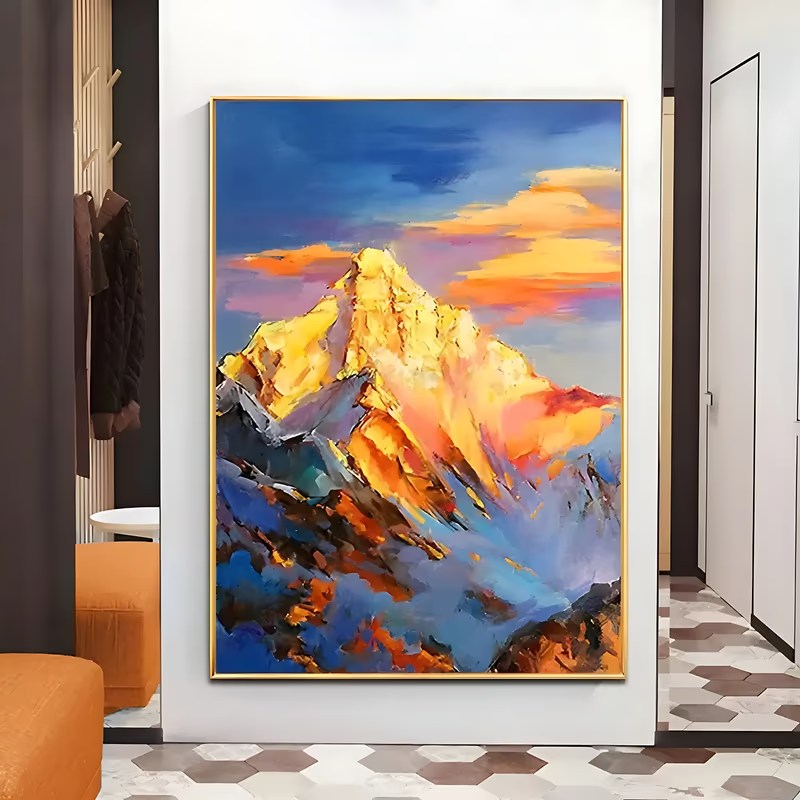 IA#069
Over the chimney breast
One square or upright canvas, a little narrower than the breast, hung clear of the mantel shelf.
Square works -
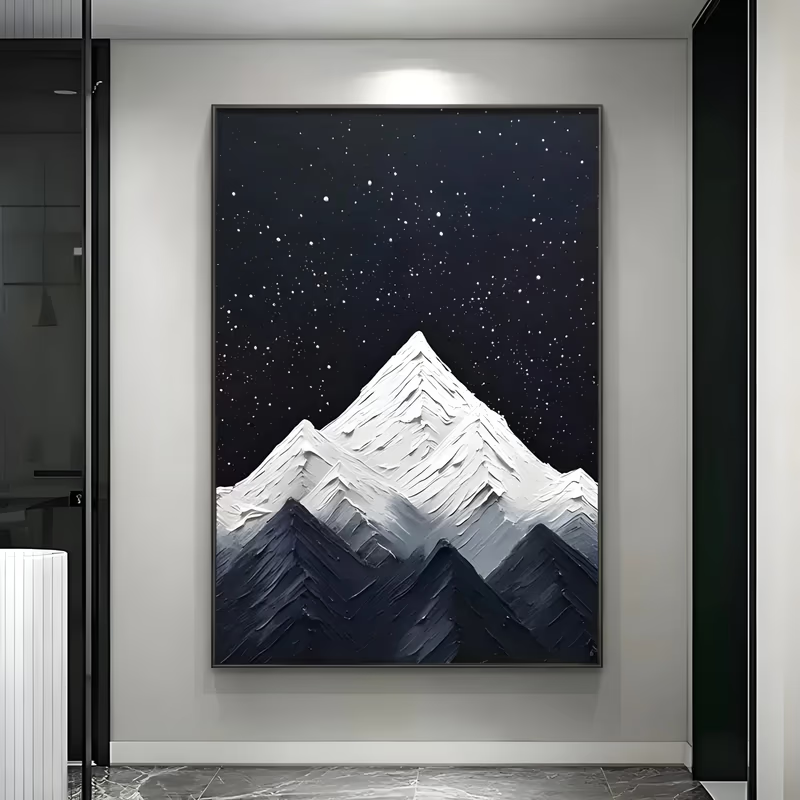 TA#807
In the alcoves
A matching pair of slim uprights, each well inside the alcove's width, or one piece above built-in shelves.
Upright works -
 IA#945
Behind the sofa
In a new-build flat, a long, low canvas about two-thirds the sofa's width, hung 20–25 cm above its back.
Horizontal works
How do you hang a large painting from a picture rail or in a listed house?
From the rail on cord or steel cable rated for the piece, or on fixings in the mortar joints rather than through old plaster; the heavier the frame, the stronger the hanging must be.
Picture rails are one of the pleasures of a period room. In Victorian and Edwardian houses they sit 300–450 mm below the ceiling, and a hang that puts the centre of the artwork about 1,450 mm from the floor reads comfortably. What the rail can carry depends on what hangs from it: traditional cord takes about 10 kg, perlon about 15 kg per line and steel cable 25 kg or more. A stretched canvas without a frame is the lightest way to put a big painting on a rail; a deep gilt frame suits a Victorian cornice but wants steel cable or a fixing into the wall.
In a listed building, be gentler still. One estate agent's 2026 guide advises hanging pictures without nails or screws into the fabric and fixing into the mortar joints between bricks, and notes that altering chimney breasts or panelling needs listed building consent while repainting generally does not. A painting is one of the easiest ways to change a listed room. In a new-build flat, use fixings made for plasterboard, or find a stud for anything large.
Which colours and subjects suit British walls now?
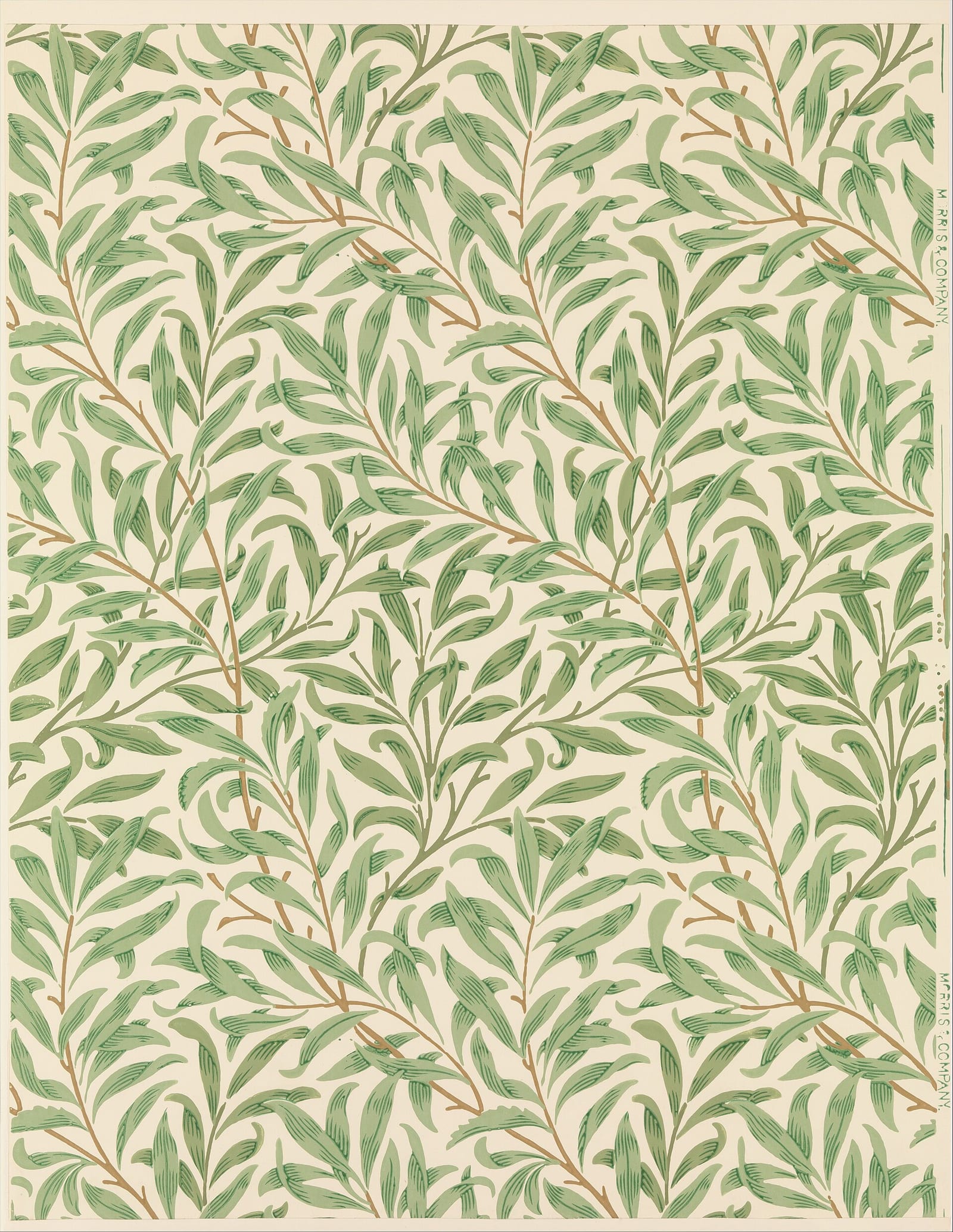
Paintings are now chosen against colour as often as against white: deep, earthy tones for dark or colour-drenched rooms, soft texture against pale plaster, and landscapes, flowers and animals reworked rather than copied.
British rooms have taken on colour. Houzz recorded searches for 'colour drench' up 142% and for pink up two and a half times in early 2025, and Good Homes' pick of the best British interior accounts divides between dark, saturated rooms and pale plaster with soft grey. Against a drenched or patterned wall a painting needs a quieter palette or a frame that sets it apart; against pale plaster, texture does the work. Send us a photograph of your paint, fabric or wallpaper taken in daylight and the palette is mixed to it.
The subjects run deep. A 1998 MORI survey found blue the British favourite and wild animals popular, with religious icons among the dislikes, and as early as 1624 Sir Henry Wotton advised cheerful paintings for dining rooms and landscapes for open terraces. Landscapes, gardens, the sea and animals still suit British walls, but heritage motifs want a fresh hand: the Highland stag has been called 'the ultimate biscuit-tin image of Scotland'. More in UK taste and styles.
Works to browse
-
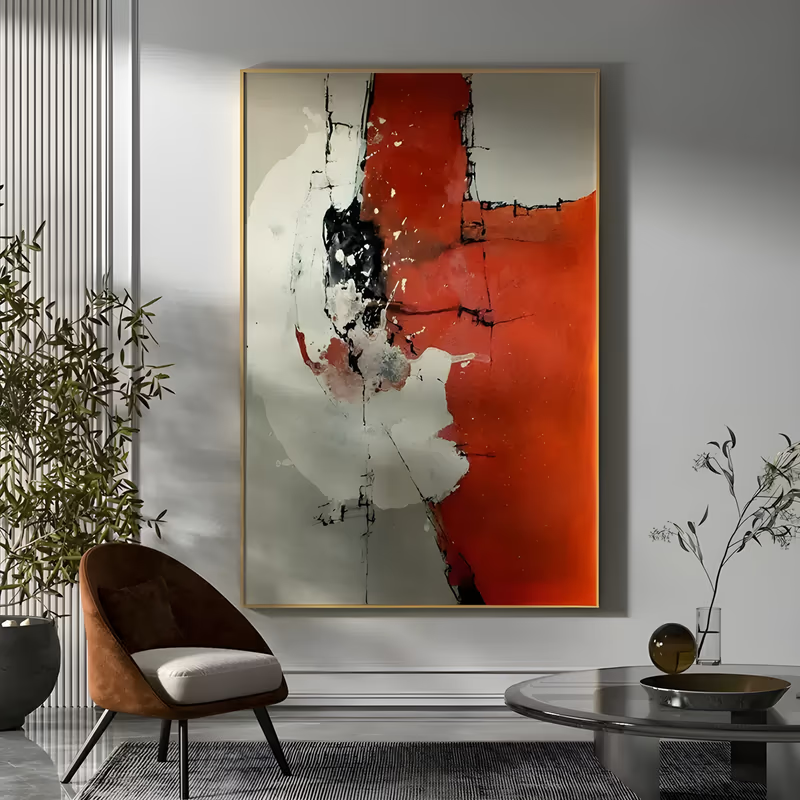
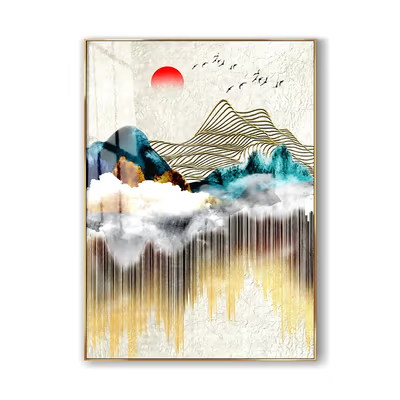 Abstract in warm terracotta, ochre, deep emerald and brown — the earthy palette the UK trade names for 2026
-
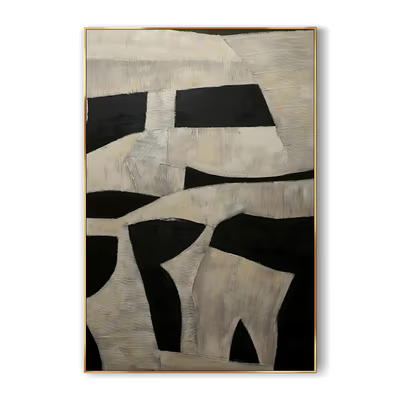 Moody works in inky blue, dark green, black and brown for dark-painted Victorian rooms
-
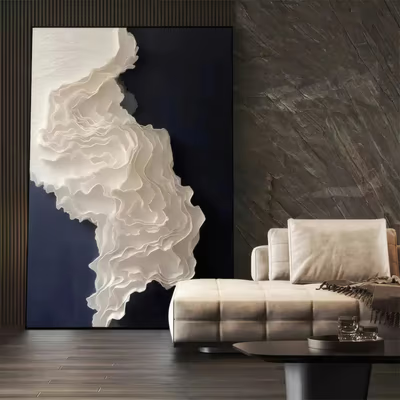 Textured & Plaster in cream, stone, white and soft grey — the pale-plaster look, with the hand visible in the surface
-
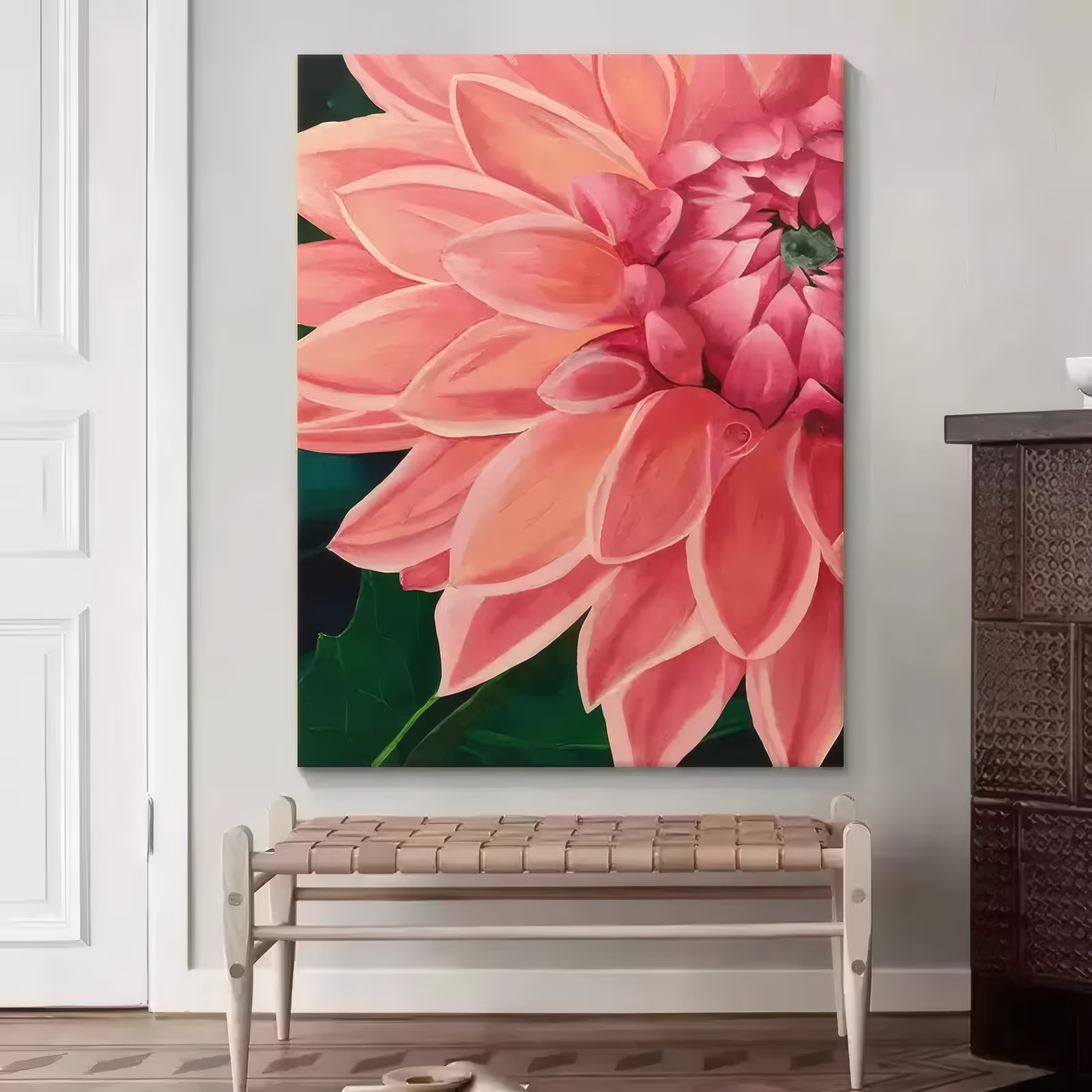
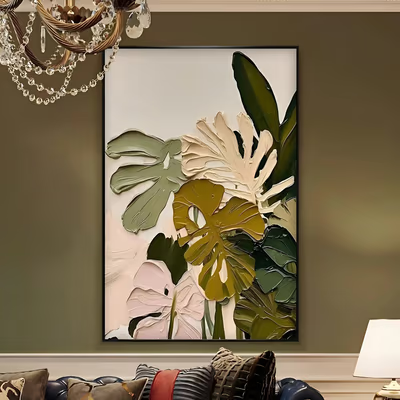 Florals and botanicals in pink and green — roses, gardens and leaf greens
-
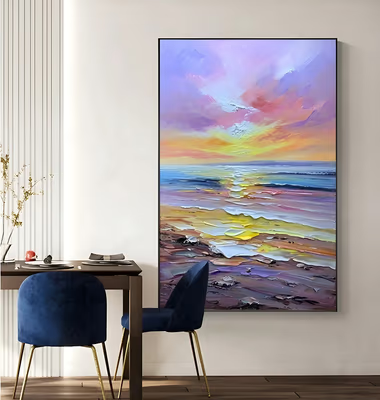 Impressionist landscapes — the first choice of buyers in the North of England and Scotland
-
 Horses, birds and wildlife in earth tones — the country-house and sporting-art register, reinterpreted
Can you commission a painting from your own photo in the UK?
Yes: send the photograph, whether of your house, a view of the Lakes, the family dog or your company's crest, with the wall size, and we tell you the size, format and finish it will paint best at.
Britain has long painted what it owns. The country-house hang grew from sets of family portraits fixed along long galleries such as the one at Knole, and the house, the horse and the dog have filled British walls ever since. Hotels still do it: at The Fife Arms in Braemar, artists in residence designed the hotel's coat of arms and painted portraits of local characters. The modern version is a painting of your own place, and it suits owners who stay put: 61% of UK renovators plan to stay eleven years or more.
Start with the photograph and the wall: the terrace you restored, the view from a cottage, a pet, or a crest or logo for an office, school or club. We look at the image, tell you how it will translate to canvas, suggest the size and finish, and paint it by hand once you are happy. You need to own the image or have permission to use it, and a design can be kept exclusive to you if you ask before we start. More on paintings from your own image.
Where do people buy original art in the UK, and when should you commission instead?
Buy at a fair, a gallery or a society exhibition when you want a particular artist's piece; commission when the wall needs a size, a palette or a matching set that nobody has on the stand.
The UK is the world's second-largest art market, with no shortage of places to buy a painting. The Affordable Art Fair drew nearly 60,000 visitors to its three London fairs in 2025; the Mall Galleries host nine artists' societies with more than 500 member artists and over 25 exhibitions a year; and the Royal Academy's Summer Exhibition, regional open shows and art-school degree shows add more. The Arts Council-backed Own Art scheme even offers interest-free loans for contemporary work at member galleries.
What a stand rarely offers is your wall. Works at a fair come in the sizes and colours the artist chose, and a run of matching pieces for a stair or a whole house is hard to gather from different hands. That is the moment to commission: when the wall needs more width than anything on offer, a palette taken from your room, a set that belongs together or a subject that is yours alone. Many buyers do both, collecting the piece they fell for and having the rest made to fit around it. Sellers and sizes are compared in where to buy art in the UK.
Measure before the fair
Take the wall's width and the ceiling height with you, so you know at the stand whether a piece will hold the wall.
Decide on a set early
If three or more walls should belong together, settle that before buying the first piece; matching later is harder.
What wall art do UK offices, clinics and public buildings hang?
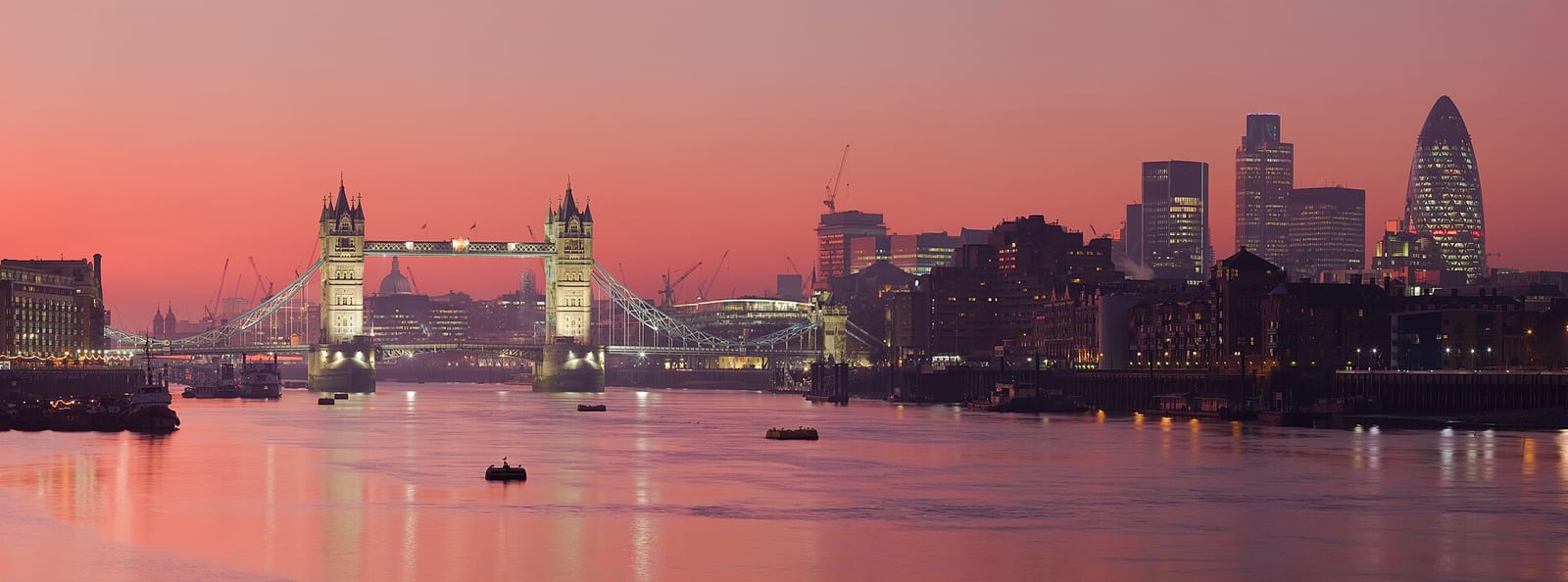
The famous City collections lean on prints, photographs and named artists; for most offices and clinics the walls that matter are reception, meeting rooms and corridors, which want large, calm canvases in one palette.
London's best-known corporate collections are built mostly on paper. Deutsche Bank's concentrates on works on paper and photography, and Clifford Chance has built a collection of more than 1,400 limited-edition prints for the public areas of its Canary Wharf tower. Most offices need something simpler: a reception wall, meeting rooms and corridors that feel looked after. The case is easy to make to a board: in a 2023 survey, 69% of UK respondents agreed that good art at work adds to their wellbeing.
Public buildings show what painting does at scale. The Government Art Collection holds some 2,500 oil paintings among its 14,000 works, hung from Downing Street to regional government offices, and Paintings in Hospitals has 1,290 works on loan to 72 hospitals. For a new floor or a clinic, a practical split is one named artist's piece for reception, then canvases made to the boardroom and corridor walls in the same palette. More on UK offices and institutions.
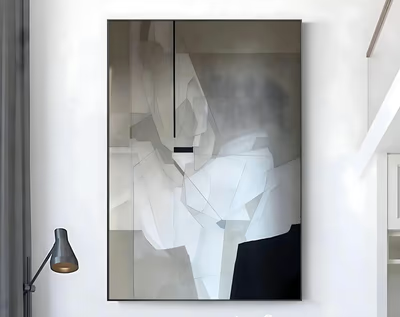
How do UK hotels, members' clubs and interior designers source art?
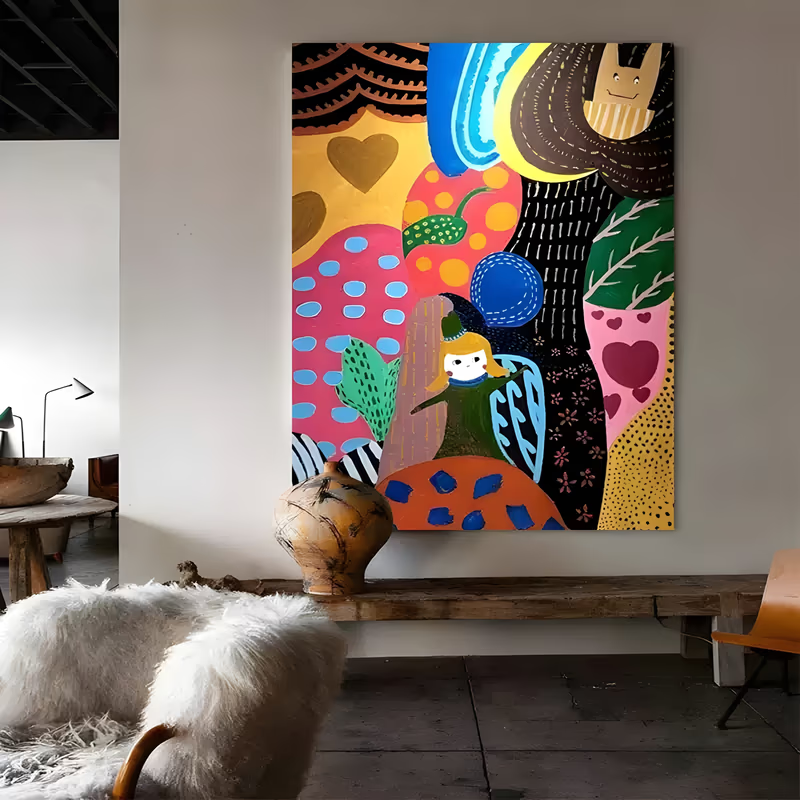
Through the designer, to a story for each property and often with a local thread; a studio that paints to order fits wherever a scheme needs many works in one palette, painted to drawings and sizes.
The UK has Europe's largest hotel pipeline: 268 projects and 39,024 rooms at the end of the first quarter of 2026, 72 of the projects in London. The big openings hang art by the hundred. The Broadwick Soho holds 350 works for 57 keys, and Mollie's in Manchester filled its rooms and public spaces with newly commissioned work by Manchester-based and northern artists. Members' clubs live with it daily: Soho House keeps about 8,000 works on permanent display, favours local artists for each House, and calls the collection 'a working horse, rather than a show pony'.
For private homes, London's design studios source art within their procurement work, and one says that where a piece does not exist, it works with artisans to create it. That is where iHomeArt fits. Designers, FF&E buyers and independent hotels send us drawings, sizes and a palette; we paint each room type to them, with one sample first if you want it, label every canvas by room or position with a packing list, and keep the order codes on file for re-orders. More on UK hotels and restaurants, and for interior designers and boutique hotels.


How do you order hand-painted wall art from iHomeArt in the UK?
Send the wall on WhatsApp, approve each stage from photographs, and choose rolled, stretched or framed by how the canvas has to reach the room.
Start with a photograph of the wall, its width and the ceiling height; your quote, priced for your sizes and finishes, usually arrives within one business day. British online shoppers like to know costs early, and 70% say clear delivery charges up front are a requirement, so we find the best route for your address and confirm the shipping cost before anything leaves.
The finish depends on the way into the room as much as on taste. Stretched canvases arrive ready to hang, and framed pieces come in gold, silver, black, white or wood; heavily textured and plaster work always travels stretched or framed. Larger orders may go by air or sea freight. If WhatsApp is not your habit, the quote form and email work just as well.
Each canvas can travel stretched and ready to hang, framed, or rolled; a rolled canvas, the lightest and most economical way to send a large painting, arrives without stretcher bars, and any local framer can stretch it for you.
UK wall art FAQs
How long does a painting take to reach London, Manchester or Edinburgh?
About 10 days to paint, then 5–7 days by DHL, FedEx or UPS express to London, Manchester, Edinburgh, Cardiff, Belfast or any other UK address. Larger orders may travel by air or sea freight instead; we choose the best route for your address and confirm the shipping cost before anything leaves.
What is the largest painting you can make for a British house?
Send us a photo of the wall with its width, the ceiling height and the way in: the stair, the landing and the narrowest door the canvas must pass.
Can you paint a copy of a Turner, a Constable or a Monet?
Yes. Works out of copyright, such as Turner's skies or Constable's Suffolk landscapes, can be reproduced by hand at the size your wall needs, never printed. A work still in copyright needs the rights holder's permission first. Send us the image and the wall size, and we suggest the format and finish.
Can I return a painting if it does not suit the room?
Every piece is painted to order and you approve a photograph of the finished canvas before it ships, so finished pieces are not returnable. Damage in transit is rare, under 0.01% of pieces; if it happens, send us photos and we take it up with the carrier and work out a solution with you, such as a replacement or a refund.
Can a painting hang above a working fireplace?
Yes, and many British chimney breasts carry one. If the fire is lit often, leave a generous gap between the mantel shelf and the canvas, keep the piece out of strong direct sun, and dust it dry rather than with sprays. In a listed house, hang it from the picture rail or fix into the mortar joints rather than drilling the chimney breast.
How do I pay for a painting ordered from the UK?
Half upfront against a proforma invoice, so painting can start, and the other half once you approve the photograph of the finished piece, before it ships. Your quote, priced for your sizes and finishes, usually arrives within one business day of your message on WhatsApp, through the quote form or by email.
Is one painting for a flat too small an order?
Not at all. The minimum order is one piece, so a single canvas for a flat in Bristol or a cottage in the Cotswolds is welcome, and it can double as a sample if you plan more. Volume pricing starts at ten pieces, for a whole house, an office floor or a run of hotel rooms.
United Kingdom
Show us the wall
Send a photo of the wall, its width and the ceiling height on WhatsApp, with the quote form or by email. We reply, usually within one business day, with a size that suits the room, a shortlist from the catalogue if you want one, and a price for each piece.
Sources
- The Art Basel and UBS Global Art Market Report 2026 (Arts Economics) · 2026-03
- Mall Galleries – About Us · 2026-09-19
- Landmark Global – 10 must-know facts about UK e-commerce, 2025 edition · 2025-09-09
- The Art Newspaper: Deutsche Bank re-hangs massive collection at new London headquarters · 2024-09-03
- The Arts Society: Clifford Chance free art tour · 2017-09-18
- Wikipedia: Government Art Collection · 2025
- Paintings in Hospitals · 2025-08
- The People's Painting | Ipsos · 1998-02
- Inside the Soho House art collection | Soho House · 2023-10-05
- Affordable Art Fair highlights ceramics | Arts & Collections · 2026
- The architectural evolution of picture and sculpture galleries in British country houses | Art & the Country House (Paul Mellon Centre) · 2020
- Could the right art get hybrid workers back in the office? | Raconteur · 2023-11-15
- About Own Art · 2026
- The Monarch of the Glen (painting) — Wikipedia · 2025
- Albion Nord Studio · 2026-09-19
- Art — The Fife Arms · 2026-09-19
- Standard Ceiling Height UK – New 2025 Regulations (Wall Panels World) · 2026-06-26
- Standard Ceiling Height UK – Everything You Need To Know In 2026 (Marraum architects) · 2026
- Living Inside a London Landmark: Battersea Power Station – Beauchamp Estates · 2024
- Galerie: The Most Spectacular Hotels to Book in London · 2026-05-13
- Hotel Designs: Mollie's Manchester – a new chapter · 2025-11-18
- Lodging Econometrics: Europe's Hotel Construction Pipeline Q1 2026 · 2026-05-13
- Massive artwork - what would you choose? | Mumsnet · 2023-10-05
- 2025 Houzz UK Emerging Trends Report · 2025-06-16
- 2025 UK Houzz & Home Renovation Trends Study · 2025-05-27
- Best interior accounts on Instagram : Goodhomes Magazine · 2024-12-16
- The Art Basel and UBS Survey of Global Collecting 2025 · 2025
- Noba & Stod — Alcove Cupboards & Shelving: Costs, Ideas & Design Guide (2026) · 2026-08-18
- BookaBuilderUK — Picture Rail Ideas for UK Homes: No-Drill Art Displays · 2026
- Robert Holmes — What Can You Do to a Listed Building Without Consent? · 2026-06-15
Researched 2026-09-19. Prices and figures are as published by the sources on the dates shown.