Europe · Switzerland · Zürich · Geneva · Basel · Lugano
Wall art in Switzerland: hand-painted for flats, villas and chalets
iHomeArt paints wall art for Switzerland by hand and to order: original canvases for flats, villas, chalets, offices and hotels in Zürich, Geneva, Basel, Lugano and the Alpine resorts, sized to your wall and your ceiling. Where most households rent and white walls dominate the living room, the painting is the colour and texture you choose yourself, so this guide starts from Swiss rooms, from a 2.5-metre new-build ceiling to a chalet gable.
Ordering wall art in Switzerland from iHomeArt
- 1 pieceMinimum order; volume pricing from 10
- Any sizePainted to the wall, oversized and multi-panel included
- About 10 daysTo paint, then 5–7 days by DHL, FedEx or UPS express to Switzerland
- Every stageApproved by photo or video before the next one starts
- 50 / 50Half upfront, half once you approve the final photograph
What Swiss walls ask of a painting
- Ceilings
- 2.30–2.45 m in 1950s–80s flats, 2.50–2.60 m in new builds, 3.00–3.50 m in Altbau
- Who owns the walls
- About 36% of homes are owner-occupied, the lowest share in Europe
- The family home
- A 4.5-room flat of 95–115 m²
- Wall colour
- White dominates Swiss living rooms
- The collector's rule
- 'Nothing may shine': matte plaster, stone and wood
The Switzerland wall art guide, page by page
Each page answers one buying question for Switzerland: the home, the office, the hotel, where to buy, the taste and the sizes.
- Villas, flats & chaletsChalet wall art, lake-villa canvases and paintings for Swiss city flats, chosen room by room.
- Offices & institutionsOffice wall art in Switzerland
- Hotels & restaurantsArt for hotels and restaurants in Switzerland, hand-painted to each wall.
- Where to buyWhere to buy art in Switzerland
- Taste & stylesSwiss wall art for lake villas, city flats and chalets
- Size guideA wall art size guide for Switzerland in cm and inches, from flats under 2.40 m ceilings to Altbau rooms, villas and chalets.
Why does one painting do so much work in a Swiss flat?
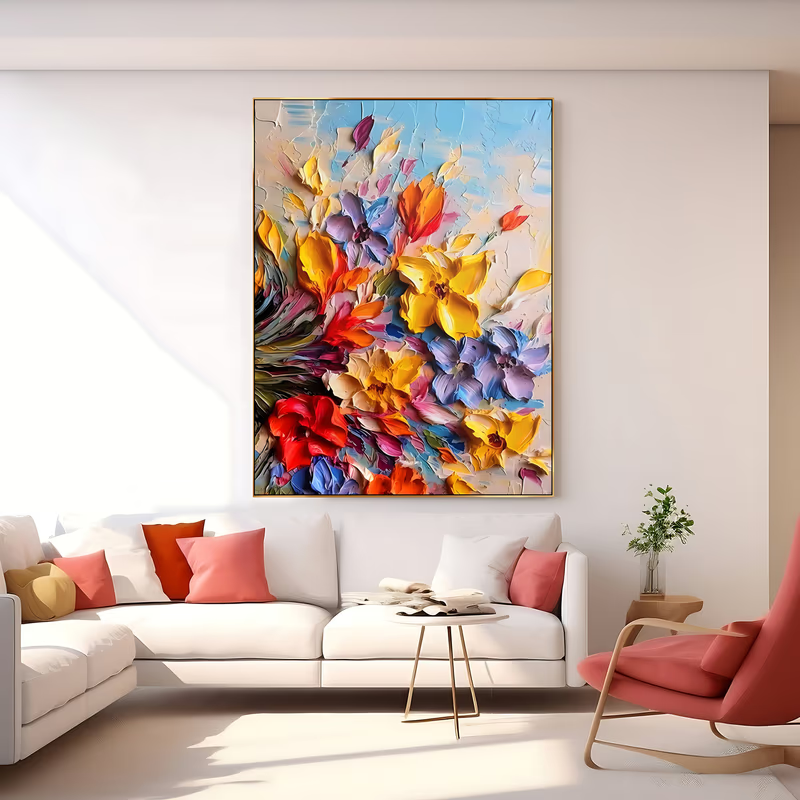
Because most people in Switzerland rent and live with white walls, the painting is the colour, texture and warmth you choose yourself, and the one part of the room that moves with you to the next flat.
Switzerland has the lowest share of home ownership in Europe, about 36% of permanently occupied homes, and in the cities it is lower still: 26.8% in Zürich, 18.9% in Geneva and 15.5% in Basel-Stadt. NZZ Bellevue observes that white walls dominate Swiss living rooms. For most buyers, then, the walls, floors and kitchen came with the flat, and the painting is the part of the room they choose and keep.
So choose a piece that brings the colour or texture a white room lacks, at a size that will still work after the next move. The typical family home is a 4.5-room flat of 95–115 m², with a living and dining room of about 20–24 m²: one canvas of 120–160 cm across the sofa wall does more there than three small ones. Lake villas and chalets, room by room, are on Swiss villas, flats and chalets.
What size of wall art suits a Swiss ceiling?
Let the ceiling decide: about 100–140 cm of canvas under the low ceilings of a 1970s flat, 120–160 cm in a new build, 150–200 cm in an Altbau, and 2 metres or more for a villa salon or stair.
Swiss ceilings vary with the age of the building more than with its price. Most cantons set 2.40 m as the minimum for living rooms; new builds usually reach 2.50–2.60 m, flats from the 1950s to the 1980s often have only 2.30–2.45 m, and pre-1940 Altbau flats 3.00–3.50 m, often with stucco. Geneva's newer villas are sold on ceilings of more than 3 m. Under a sloping roof, a room often counts as living space once about two-thirds of it reaches 1.50 m, so in an attic or a chalet's top floor only the knee wall and the gable take a painting.
| Building | Clear ceiling | A canvas that holds the wall |
|---|---|---|
| 1950s–1980s flat | 2.30–2.45 m | 100–140 cm wide, horizontal, over the sofa |
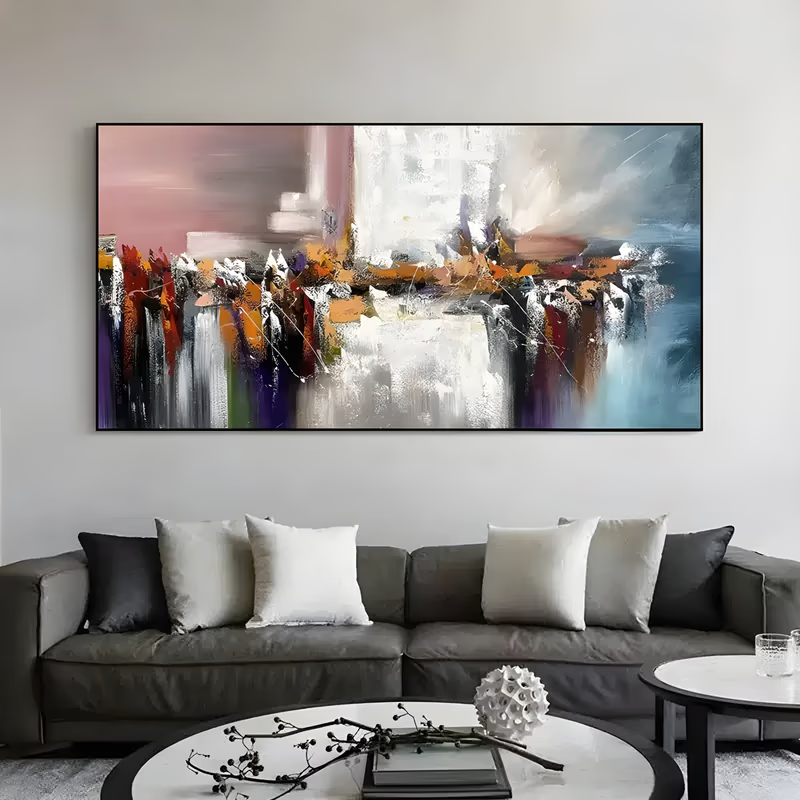
| New build | 2.50–2.60 m | 120–160 cm wide, or a long panoramic above a low sideboard |
| Altbau | 3.00–3.50 m | 150–200 cm, vertical or square, or a stacked pair |
| Villa salon or stair void | Over 3 m, often double height | 200–250 cm or more, panoramic or tall |
| Attic or chalet top floor | Sloping roof | Low and wide on the knee wall, tall on the gable |
Every iHomeArt piece is painted to the dimensions you give us, so a catalogue size is a starting point, not a limit. Hanging heights, and sizes in centimetres and inches, are in the Swiss size guide.
Works to browse
-
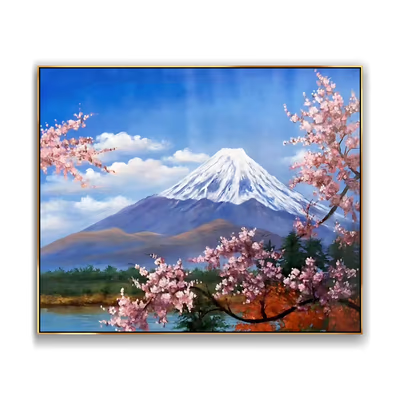 Horizontal formats for the new-build 4.5-room flat: one canvas across the sofa wall under a 2.5 m ceiling
-
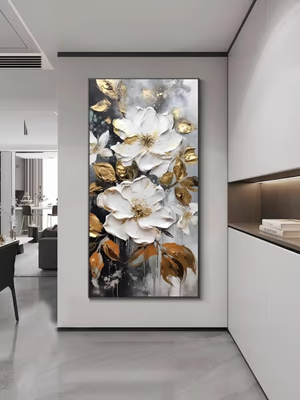 Tall vertical works listed at 250 cm and above for the villa stair void, the double-height foyer and 3–3.5 m Altbau rooms
-
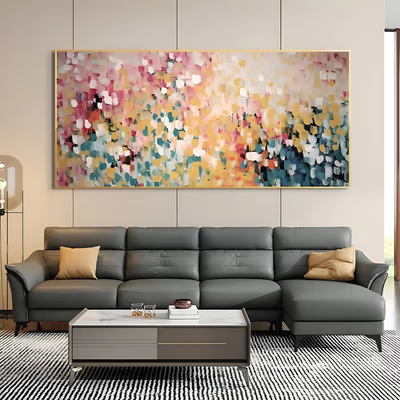 Panoramic formats listed at 250 cm and above for the 6–10 m salon wall and the long sight axis
Which wall art suits a Swiss interior where nothing should shine?
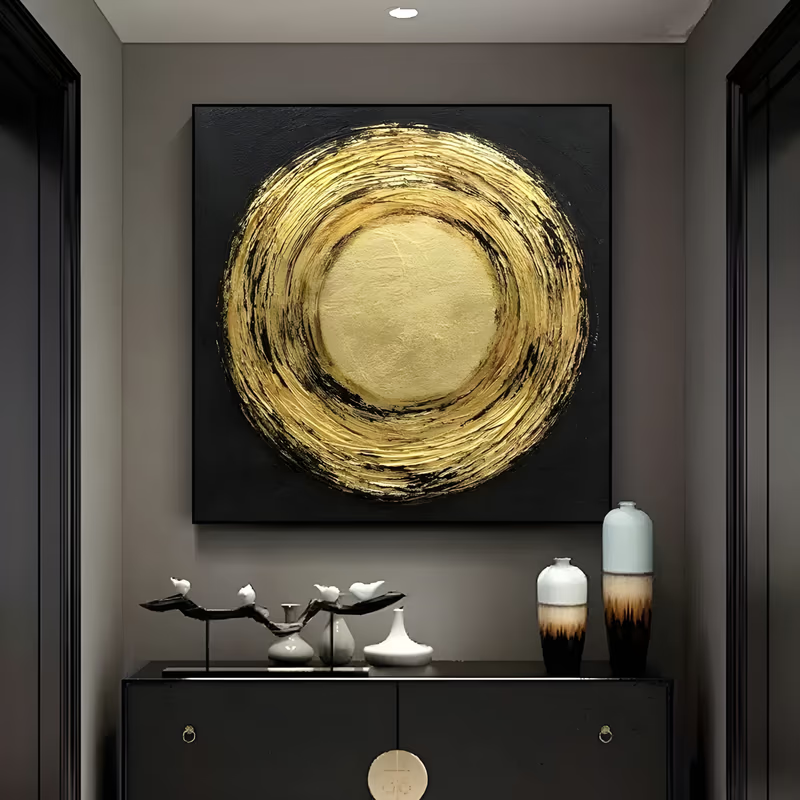
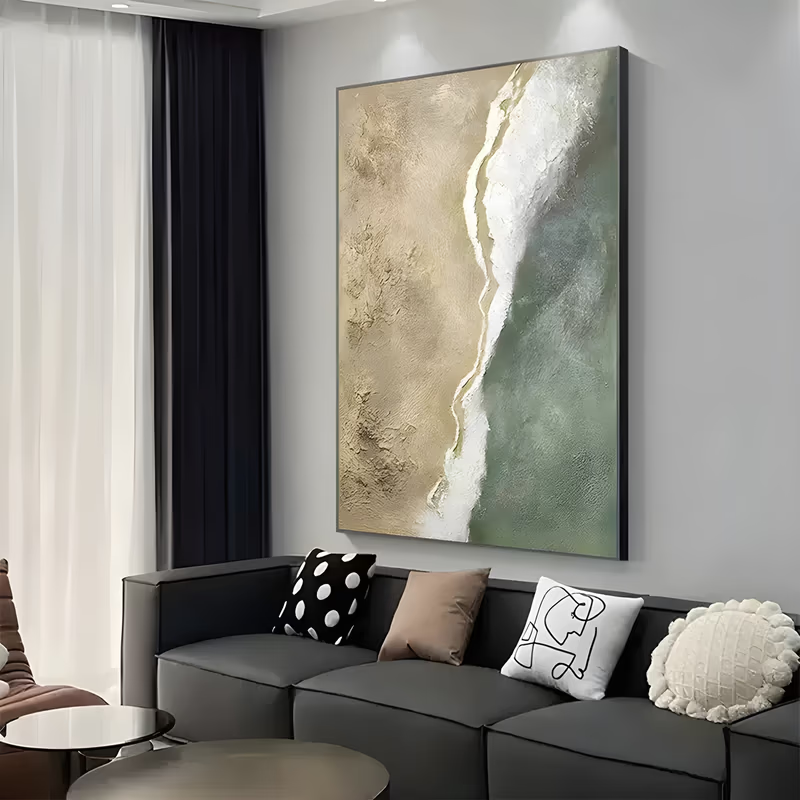
Matte, textured and tonal work in sand, stone, cream, olive and earth, or one reduced abstract gesture: art that gives a pale wall depth and warmth rather than gloss or noise.
The Swiss interiors people talk about are quiet ones. The owner of a new art villa on Lake Zürich's Goldküste set one rule for the whole house, that nothing may shine: no polished stone, no lacquer, and walls of mineral plaster deliberately left unsmoothed. In a renovated 1960s house on the same lake, the art is described as neither showy nor conspicuous, blending into rooms of soft green. The Zürich interior architect Iria Degen avoids pure white altogether in favour of warm cream and light beige.
Paintings for these rooms share the restraint. Plaster, impasto and palette-knife relief give a white or cream wall depth without colour noise; tonal abstracts in sand, stone, olive and grey sit with oak and limestone; and a single reduced gesture suits a modern flat, the register of a Zürich painter whose one-brushstroke abstracts drew millions of views on Instagram in 2025. Strong colour still has a place, as one accent in a calm room. Subjects and palettes in more depth are on Swiss taste and styles, and textured work on textured paintings.
Works to browse
-
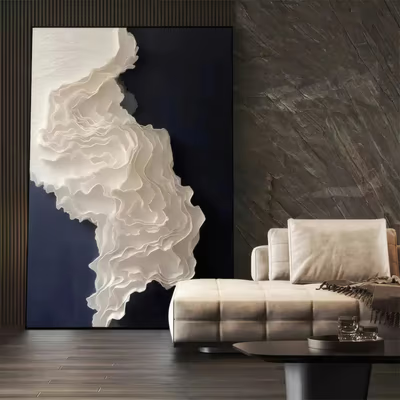 Textured & Plaster in white, cream, beige and grey — the matte mineral-plaster and limestone register of the lake villas
-
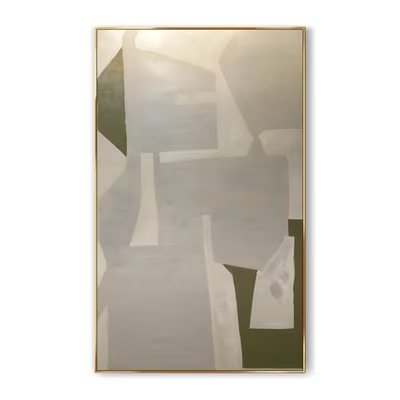 Wabi-Sabi in stone, earth and wood tones for the 'nothing may shine' interior
-
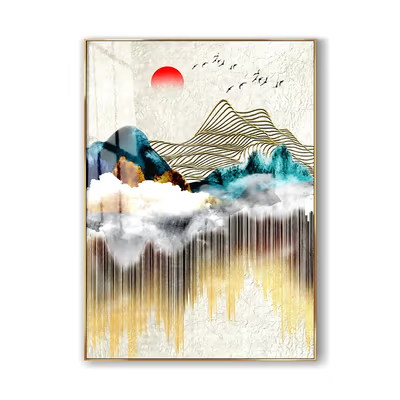 Abstract in beige, brown, ochre and grey — matter-painting tones for plaster, oak and limestone rooms
-
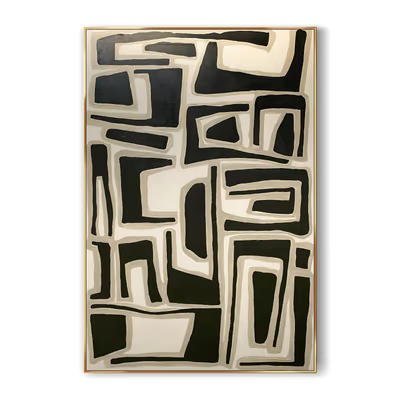
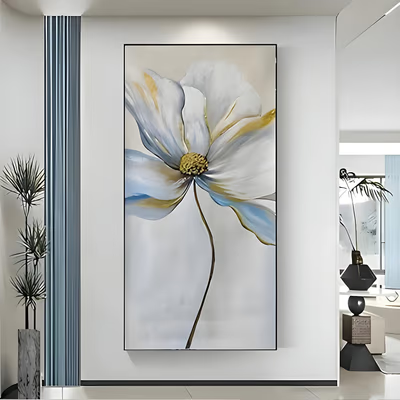 Contemporary Minimalist in black, white, grey and cream — the monochrome and single-gesture register Zürich collectors and studios sell
Do Zürich, Geneva and Lugano hang art differently?
In scale and mood more than in subject: Zürich leans minimal and mineral, Geneva towards tall-ceilinged apartments and lake villas with a French eye, and Ticino towards Italian design held in check by Swiss sobriety.
The three language regions share the calm palette but not the rooms. On Zürich's Goldküste, one collector hangs Swiss contemporary work against matte plaster. Interior architects from Paris and Lyon court Geneva as a luxury market, with typical work in Eaux-Vives apartments and Cologny family villas, and an apartment in an older building near Parc Bertrand is marketed on its tall ceilings and parquet. In Ticino, one studio sums up its brief as Italian design taste with Swiss sobriety, functionality and precision, and a Lugano architect calls minimal, all-white homes the usual Swiss preference. A Milan designer described his aim for a villa above Lugano as forms, colours and materials that age with dignity. So choose scale and finish for the region's rooms, as below.
-
Zürich and the Goldküste
- The rooms
- Altbau flats, new builds, lake villas
- The look
- Matte plaster, oak, limestone, little colour
- Paint for it
- Textured or tonal work, one reduced abstract
-
Geneva and the lake shore
- The rooms
- Tall-ceilinged apartments, Cologny villas
- The look
- Parquet and height, a French designer's eye
- Paint for it
- Tall verticals and wide salon pieces
-
Lugano and Ticino
- The rooms
- Lake-view villas and apartments
- The look
- Italian design with Swiss restraint
- Paint for it
- Timeless subjects in colours that age well
What wall art holds its own in a chalet?
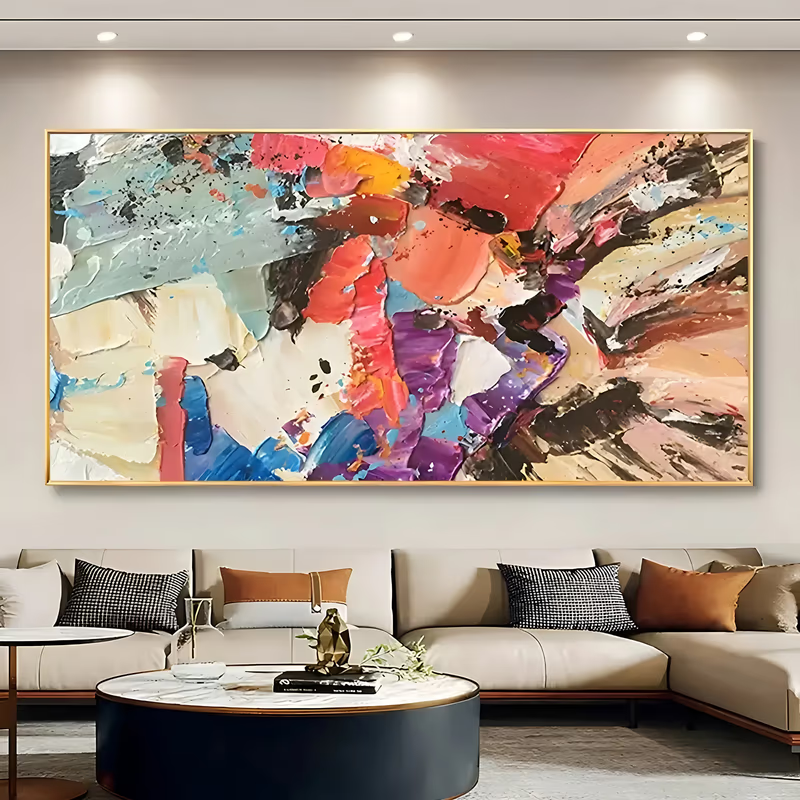
Work with contrast or warmth: against larch, stone and panelled ceilings, strong abstraction, deep colour or a dark ground holds the wall, where a pale, quiet canvas can fade into the wood.
The chalet is the warm exception to the white Swiss room. A Gstaad apartment by Nicky Dobree pairs panelled ceilings with tartan and cashmere, and a Saanen chalet renovated by Thierry Lemaire mixes rough larch and smooth Hainaut stone with old paintings and vintage furniture. Collectors hang strong work there: the walls of one Gstaad chalet by Paolo Moschino carry Riopelle and Tàpies. Chalet owners have long wanted pictures with a sense of place, too; a 2012 report on Swiss art sales described owners of new chalets in Valais looking for the real thing.
Three checks before you order. The wall: under the roof only the gable or the knee wall is tall enough, so measure it. The palette: earth, rust, deep blue and high contrast read against timber.
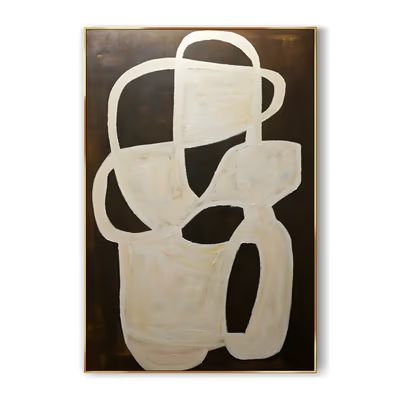
Can you have your own view of the Alps, an Anker or your crest painted?
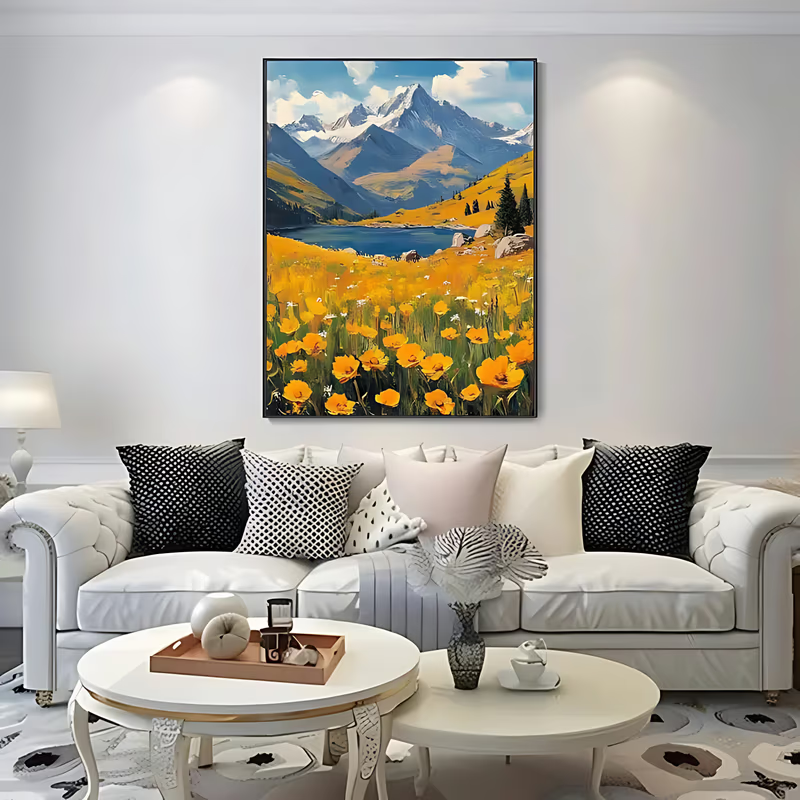
Yes: send us the photograph, the painting you love or the logo, and we tell you the size, format and finish it will paint best at; the view from your own window often makes the best Alpine picture of all.
Switzerland's own Alpine art is specific: the paper-cuts of the Saanenland go back to Johann Jakob Hauswirth, who cut Alpine processions in the 19th century, and the craft still has its own national exhibition. A mountain on your wall works best the same way, by being particular: a landscape in the real colours of a season, snow light, granite grey or a summer meadow under the peaks; or your own view, painted from your photograph: the Eiger from the chalet balcony, the lake from your flat, your village or your house.
Classic Swiss paintings can be painted by hand, too. One critic calls Albert Anker the country's best-loved painter, and few second-hand shops lack prints of his quiet domestic scenes; his work and Ferdinand Hodler's lakes and mountains are long out of copyright, so they can be painted at the size your wall needs. A work still in copyright needs the rights holder's permission, and a company logo or family crest has to be yours or used with permission; a design can be kept exclusive to you if you ask before we start. More on paintings from your own image.
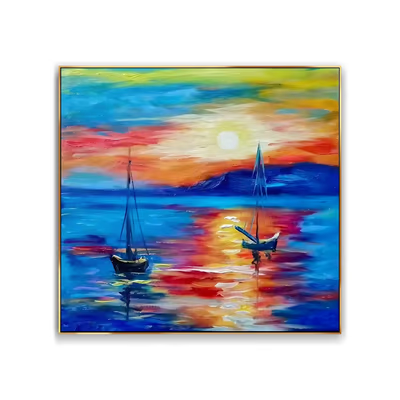
Where can you buy wall art in Switzerland, and when is made to order the better route?
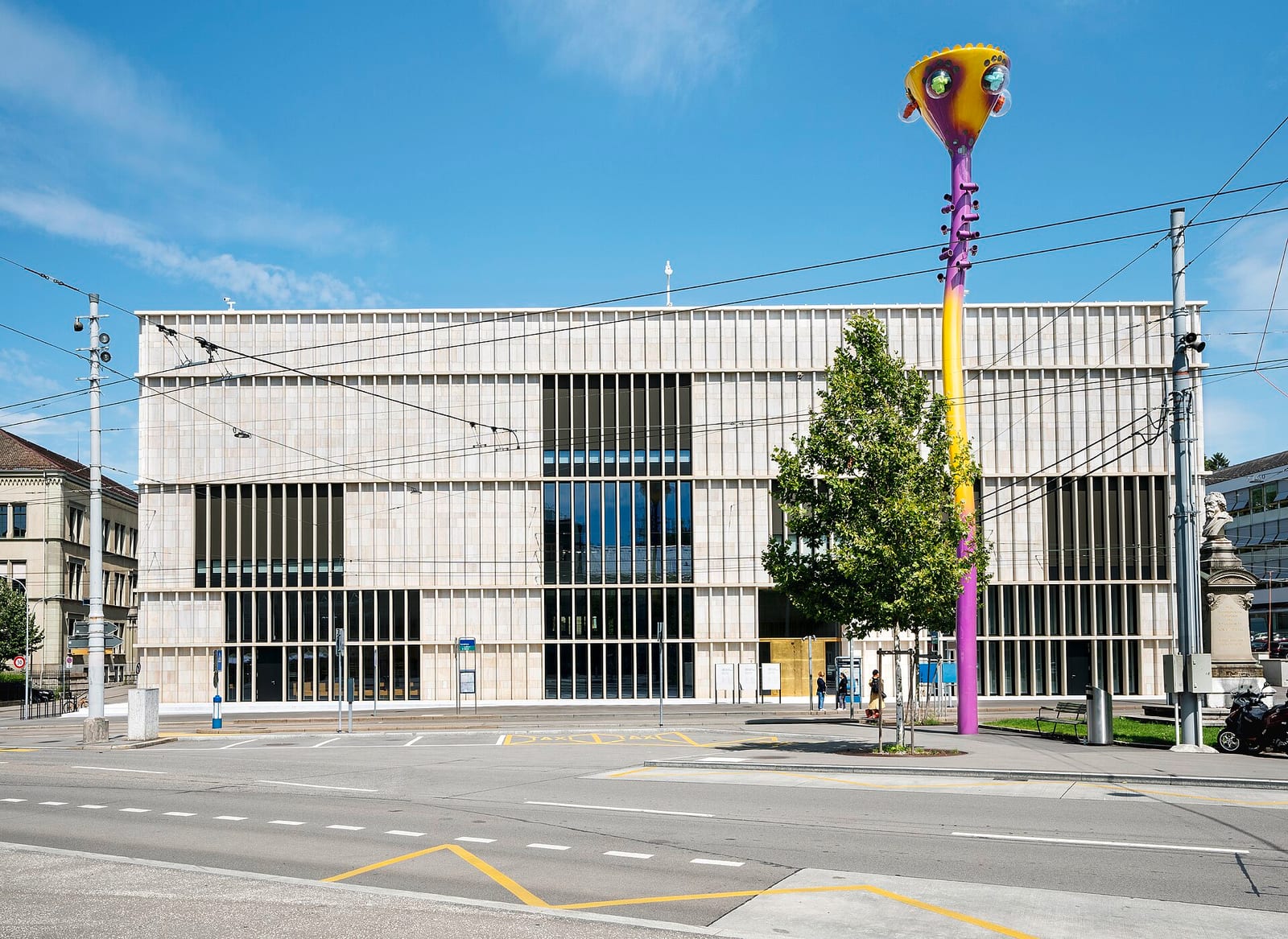
A furniture store suits a quick, ready-made piece and a gallery or fair the artist you collect; once the wall needs more than about 1.5 metres of hand-painted canvas, a colour nobody stocks or a set that belongs together, you are commissioning.
Swiss supply comes in tiers. Furniture chains and online shops sell printed canvases, some with texture applied by hand over a print, and their fully hand-painted pieces rarely pass 1.5 m. Independent painters take commissions, each in their own style. At the top, galleries and fairs sell named artists: Art Basel drew 290 galleries and 90,000 visitors in June 2026, and Art Genève 81 galleries in January. Wealthy collectors in a 2025 survey that included Switzerland bought mostly through galleries, and more and more at fairs and on Instagram.
A practical split: one piece by an artist you follow, from a gallery, for the wall people remember; then canvases painted to order, at the size and in the palette of each room, for the rest. Hand-painted should mean brushwork you can see in side light, not texture over a print; with iHomeArt you see your own canvas in photographs at every stage. Each kind of seller, and where it stops, is on the Swiss art market page.
Each canvas can travel stretched and ready to hang, framed, or rolled; a rolled canvas, the lightest and most economical way to send a large painting, arrives without stretcher bars, and any local framer can stretch it for you.
Who chooses the art for Swiss offices, clinics and hotels?
Rarely a buying agent: in the big banks a curator, in public buildings an art competition, in hotels the owner family or the interior designer; canvases painted to order fill the floors and rooms around the pieces they collect.
Swiss companies take art seriously. Julius Baer hangs its 5,000-plus works, focused on contemporary Swiss art, in meeting rooms, staff restaurants, offices, foyers and corridors, holding that art at work encourages conversation. Collections like this are built around Swiss artists, and public buildings commission site-specific work through art competitions. Many practices, law and consulting firms and regional companies have no curator, and that is where canvases painted to the reception, meeting rooms and corridors in one palette help most: see Swiss offices and institutions.
Hotels follow the owner. The Dolder Grand shows around 100 works by 90 artists, chosen by the Schwarzenbach family, and the Widder's collection was assembled by its architect, Tilla Theus. The ideas travel to smaller houses: Hotel Monopol in St. Moritz gives each floor to one artist, and the Schweizerhof Luzern gave each of its 101 rooms a wall graphic telling a former guest's story. For a small Alpine hotel, a series per floor or room type, with one sample first, is the practical route; more on Swiss hotels and restaurants.
Works to browse


How does ordering wall art in Switzerland from iHomeArt work?
Much as Swiss interior firms work: a written quote, a deposit, your approval at each stage from photographs, and a finish chosen for the way the canvas reaches your room.
The terms will feel familiar. One Swiss interior firm reserves the right to 30–50% prepayment, treats an order as agreed only once confirmed in writing and does not take back custom-made pieces; another accepts orders by letter, e-mail or WhatsApp. With us, send a photo of the wall, its width and the ceiling height; start from some 1,300 catalogue designs or have a piece designed for your project, and your quote usually arrives within one business day. Half is paid upfront against a proforma invoice and half once you approve the photograph of the finished canvas, before it ships; the next stage starts only when you say yes.
Then choose the finish for the route. Each canvas is labelled for its room, with a packing list, which helps when several pieces arrive for a chalet or a hotel floor.
Wall art in Switzerland FAQs
How long does a painting take to reach Zürich, Geneva or a chalet in the Alps?
About 10 days to paint, then 5–7 days by DHL, FedEx or UPS express to any Swiss address, from a flat in Basel to a chalet in Verbier or Zermatt. Larger orders may travel by air or sea freight instead; we choose the best route for your address and confirm the shipping cost before anything leaves.
What is the largest painting you can make for a Swiss wall?
Send us a photo of the wall with its width and ceiling height, and tell us how the piece will reach the room: by lift, stairwell or chalet stair. We look at it and suggest the size, format and finish that suit, whether one large canvas sent rolled and stretched near you, or a two- or three-panel set that hangs as one.
Is one painting for a rented flat too small an order?
Not at all. The minimum order is one piece, so a single canvas for a flat in Zürich, Geneva or Lausanne is welcome, and it can serve as a sample if you plan more. Volume pricing starts at ten pieces, which suits a chalet, a villa, an office floor or a run of hotel rooms ordered together.
Can you match the colours of my sofa, wallpaper or stone floor?
Yes. Send photographs of the fabric, wallpaper, stone or paint taken in daylight, ideally beside a sheet of white paper, and the palette is mixed to them. You see the colours on your canvas in the stage photographs and approve them before the next stage starts, so the piece sits with your room, not just with the catalogue.
Are your paintings acrylic or oil?
Acrylic on canvas is our standard, and oil is available on request. Every piece is painted by hand and nothing is printed: the relief of a plaster or palette-knife work is built up by hand, stage by stage, and we can send a side-lit photograph so you can judge the texture before you approve the next step.
Can a painting hang in a bathroom or near a wood stove?
Yes, with sensible placement; one Lake Zürich villa hangs a painting in its bathroom. Keep the canvas out of the splash zone and away from direct steam, the stove and strong sun, in a room that is aired regularly. To clean it, dust it with a dry cloth and avoid sprays.
Can I return a painting if it does not suit the room?
Every piece is painted to order and you approve a photograph of the finished canvas before it ships, so finished pieces are not returnable. Transit damage is rare, under 0.01% of pieces; if it happens, send us photos and we take it up with the carrier and work out a solution with you, such as a replacement or a refund.
Switzerland
Send us your wall and your ceiling height
Send a photo of the wall, its width and the ceiling height on WhatsApp, with the quote form or by email, whether it is a flat in Zürich, an apartment above Lake Geneva or a chalet gable. We usually reply within one business day with a size that suits the room, a shortlist from the catalogue and a price for each piece.
Sources
- Auction highlights renewed interest in Swiss art – SWI swissinfo.ch · 2012-06-04
- AGB – DAVINCI Interior Design AG · 2025
- Allgemeine Geschäftsbedingungen – 85d innenarchitektur · 2025-10
- Julius Baer Art Collection | About · undated (page live 2026-09)
- Kunst und Bau ermöglichen | Stadt Zürich · undated (page live 2026-09)
- SRF: Jahrhundertealte Tradition – Der Schweizer Scherenschnitt hat ein neues Zentrum · 2022-12-05
- artmagazine.cc: Albert Anker – Schöne Welt. Zum 100. Todestag · 2011-02-24
- NZZ Bellevue – Wie ein Haus am Zürichsee zur Galerie wird · 2026-07-27
- NZZ Bellevue – Innenarchitektin Iria Degen über gutes Interior Design · 2026-01-13
- Monocle – Three stunning cabins to discover in the Swiss Alps · 2025-12-24
- Laurent Galle – Architecte d'intérieur & décorateur à Genève · 2026-09-18
- Zimmer zählen: Ganze und halbe Zimmer erklärt (hausinfo.ch) · undated, accessed 2026-09-18
- Raumhöhe in der Schweiz – Mindesthöhe und Vorschriften (Neho) · undated, accessed 2026-09-18
- Wie gross müssen Räume sein? (Architektieren.ch) · undated, accessed 2026-09-18
- Biens vendus – Leonard Properties (Geneva) · undated, accessed 2026-09-18
- 20 Minuten — Ein Pinselstrich, Millionen Klicks: Schweizerin wird Kunst-Star · 2025-10-25
- Art Basel 2026 closes with strong sales and global engagement · 2026-06
- L'édition d'Art Genève 2026 rassemble 81 galeries (RTS) · 2026-01-30
- Paolo Moschino — Gstaad Chalet · 2026-09-18
- hoog.design — Gstaad (Nicky Dobree) · 2026-09-18
- Art Basel — The Art Basel and UBS Survey of Global Collecting 2025 · 2025
- FINA: 1,4 Mio. Haushalte mit Wohneigentum (BFS data) · 2024-03-18
- NZZ / Sustainable Switzerland: Nur rund jeder Dritte wohnt im Eigenheim · 2024
- NZZ Bellevue / NZZ Residence — Umbau-Projekt am Zürichsee · 2024-10-01
- Raum und Wohnen — Die Magie des Sees · 2026-08-08
- Angelo Pozzoli Architetto — Progettazione interior design villa a Lugano · 2015
- InterniARS — Progettazione, ristrutturazione e arredamento interni Svizzera italiana · 2026
- htr.ch – 101 Zimmergeschichten im Luzerner «Schweizerhof» · 2014-05-13
- finews.ch – Wo Skulpturen, Gobelins und Videos zum Inventar gehören · 2024-01-31
Researched 2026-09-19. Prices and figures are as published by the sources on the dates shown.