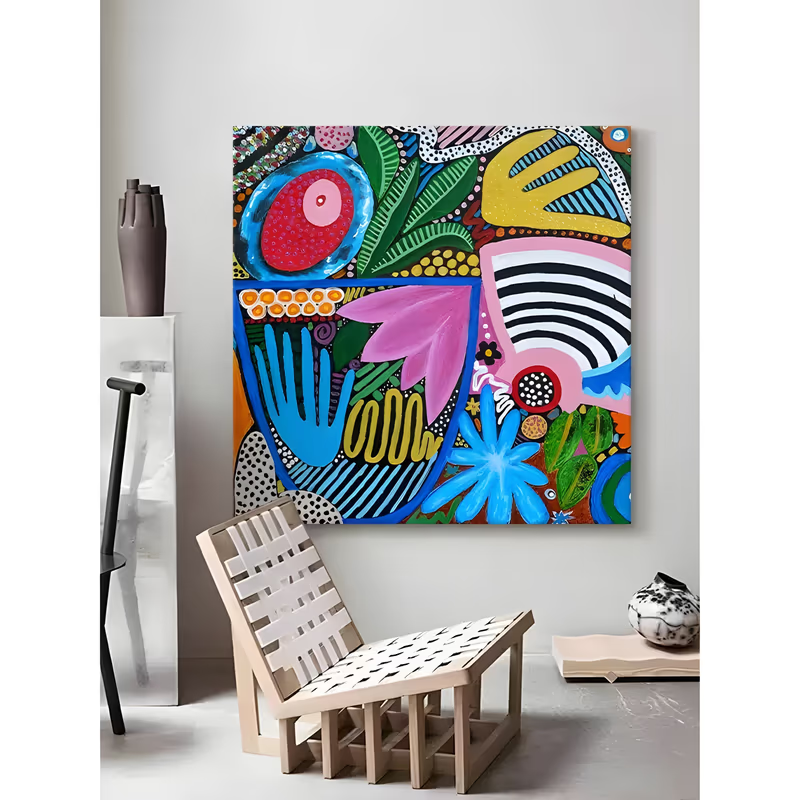
Maximalist art guide · Updated
How to choose maximalist wall art without the clutter
Key takeaways
- Let one canvas carry the pattern: a single dense painting gives a room maximalist energy with far less visual noise than dozens of small frames.
- Fix a colour story: four or five colours repeated across art, fabric and paint make abundance look planned rather than accidental.
- Change the scale of pattern: pair a tightly packed painting with a broad-patterned wallpaper or rug, never two patterns of the same size.
- Give the eye an edge: a frame, a plain border of wall or a solid sofa beneath the canvas stops the pattern from spilling into the room.
What is maximalist wall art?
Maximalist wall art is painting with no empty corners: many motifs, many colours and pattern carried right to the edges, so the canvas feels abundant and alive.
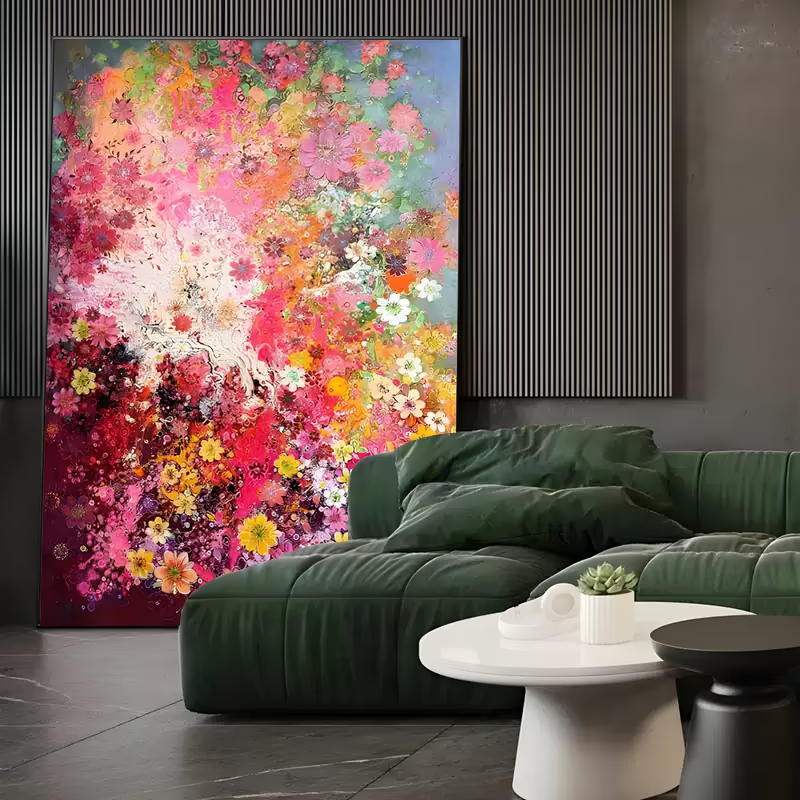
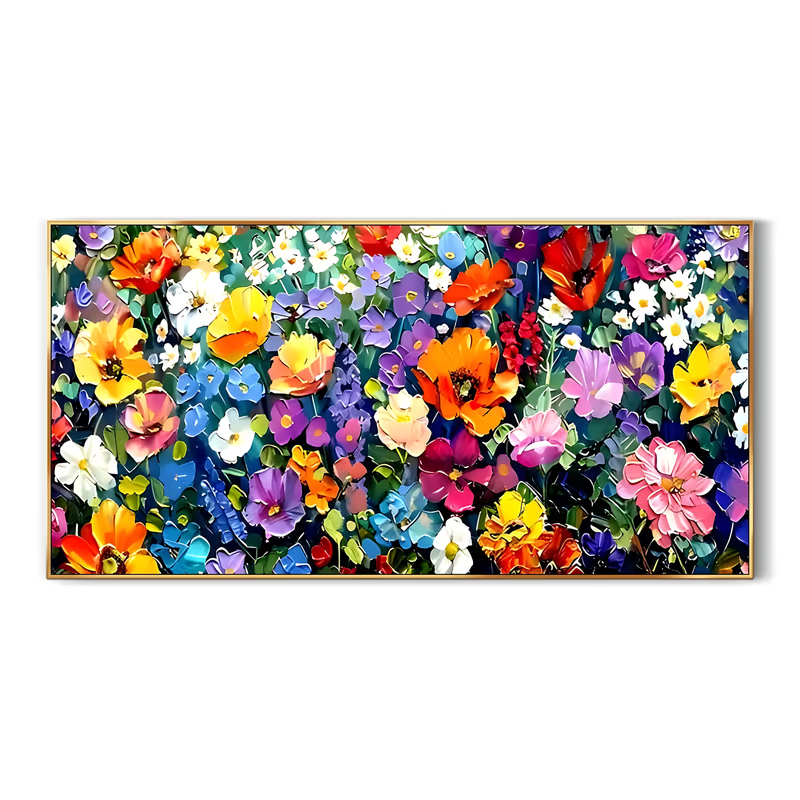
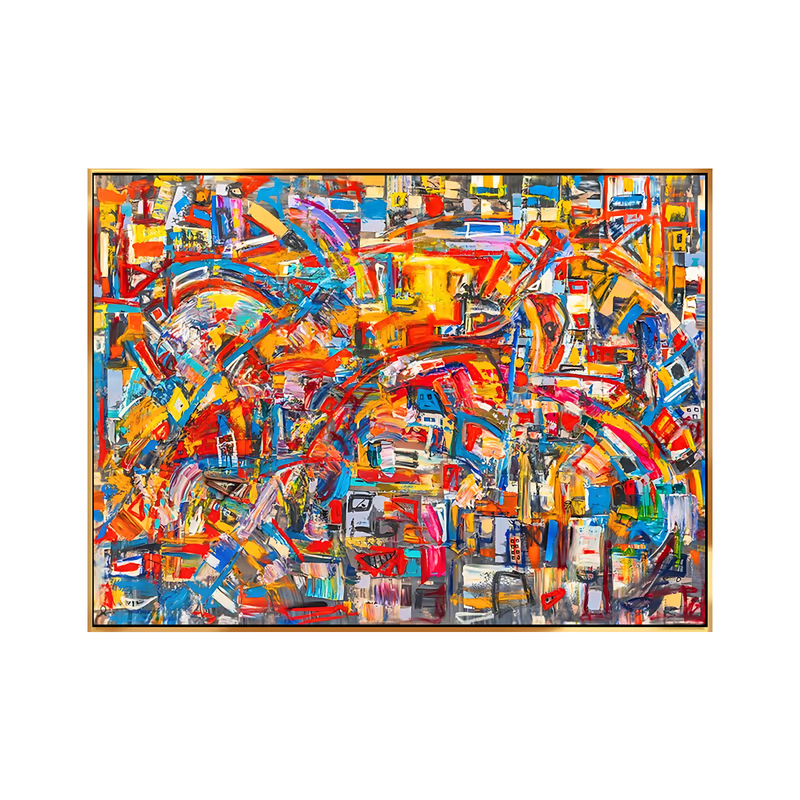
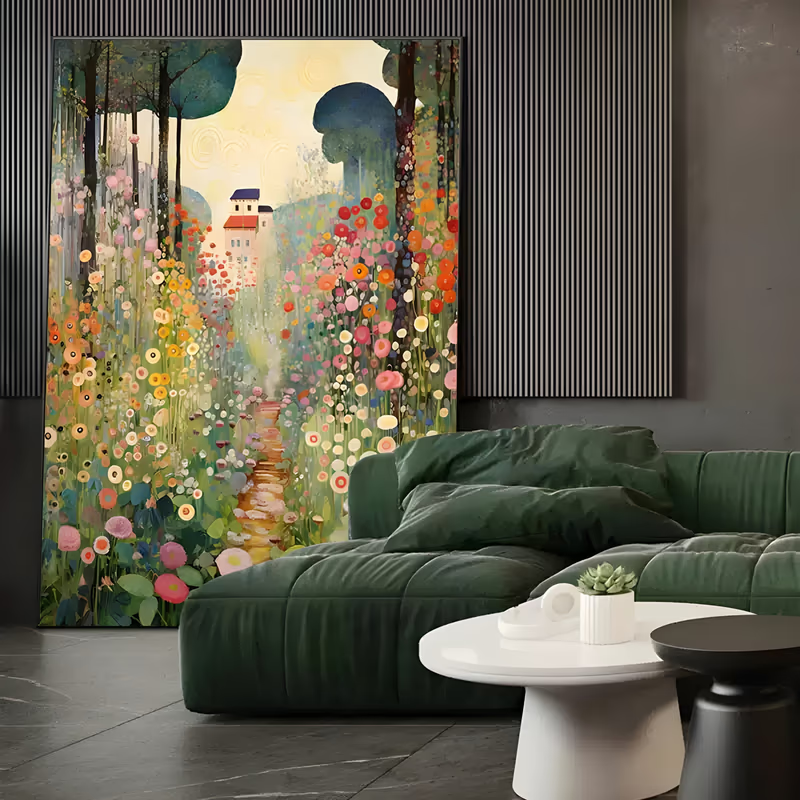
Maximalism in interiors means deliberate abundance: rich colour, layered pattern, collected objects and personality on every surface. On a wall, it is usually done with a crowded gallery of frames. A maximalist painting does the same job inside one canvas. A meadow is painted as a sea of individual flowers rather than a green field; a city becomes a mosaic of small coloured blocks; leaves, seed pods, fruit and dotted shapes are collaged over each other until the ground almost disappears.
The eye never finishes with such a painting. From the door it reads as rich colour and rhythm; up close it keeps offering small discoveries, a pansy hidden among poppies, a scratched star, a tiny house on a hill. That is why a single piece can hold a room that would otherwise need a whole wall of pictures.
How is maximalist art different from colorful or eclectic art?
Maximalist art is about density, colorful art is about saturation, and eclectic art is about mixing sources; a maximalist painting can even be quite muted, as long as it is full.
| Style | How full the canvas is | Palette | Pattern | Typical role |
|---|---|---|---|---|
| Maximalist | Packed edge to edge | Often many hues, but can be earthy | Small pattern repeated across the whole surface | Hero piece in a layered room |
| Colorful | Varies; often a clear subject with space around it | Saturated, one lead hue | Bold strokes, broad areas of colour | Bright focal point in a calm room |
| Eclectic wall | Spread across many frames | Whatever the collection holds | Mixed eras, styles and media | Gallery wall of collected pieces |
| Minimalist | Mostly empty | Neutral with one accent | One shape or line | Counterweight in a busy room |
The practical difference shows on the wall. A colourful painting needs quiet around it to shine. A maximalist painting is designed to sit happily among other patterns, because its own surface is already made of them.
What kinds of maximalist paintings are there?
Maximalist paintings here come in two families: dense flowers and foliage, and pattern-built scenes and abstracts drawn from folk art, cities and graphic marks.
Maximalist flowers, leaves and gardens
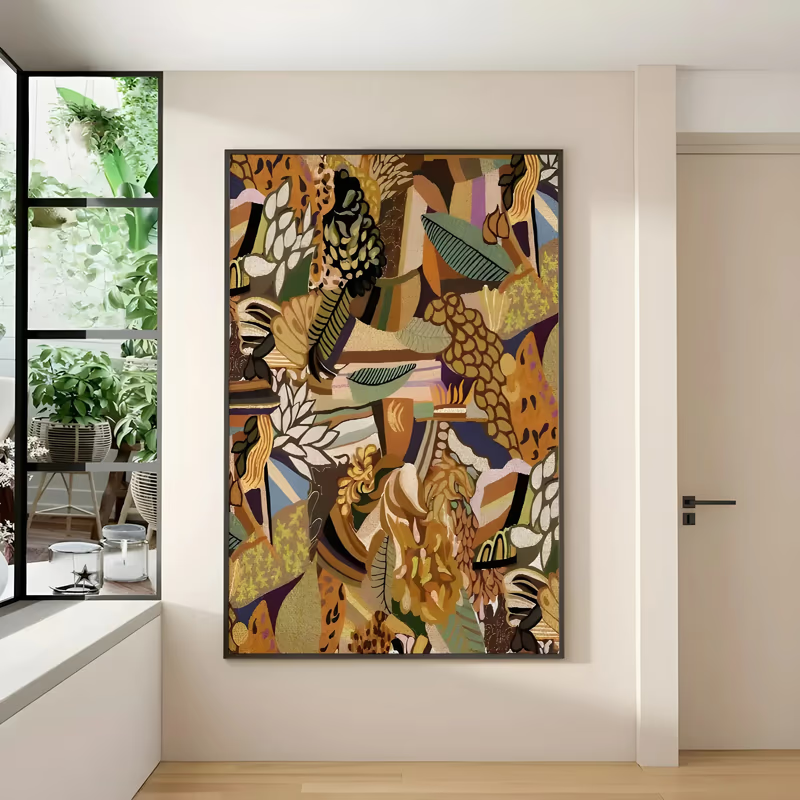
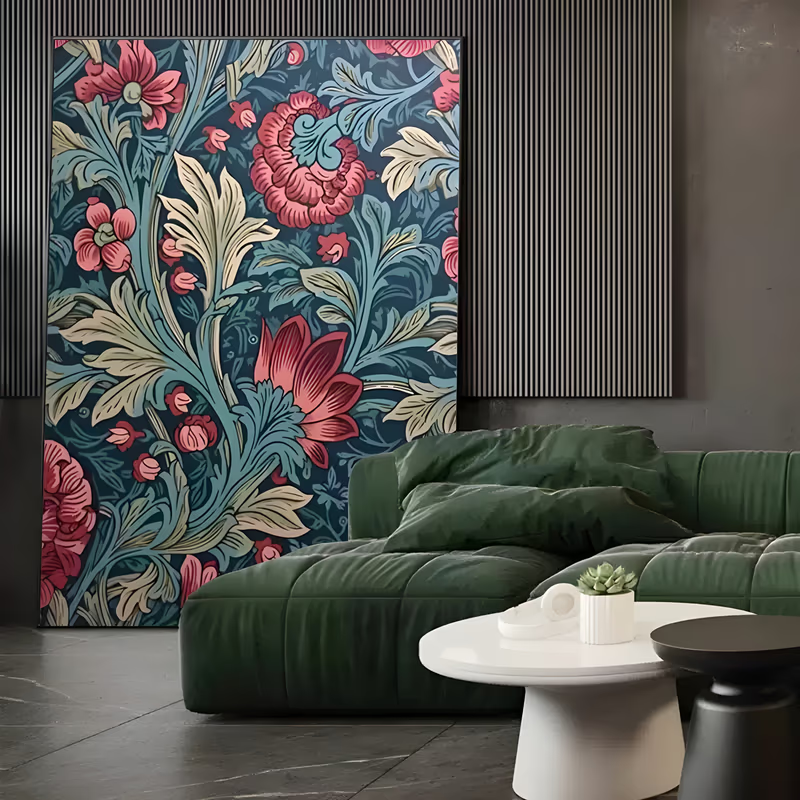
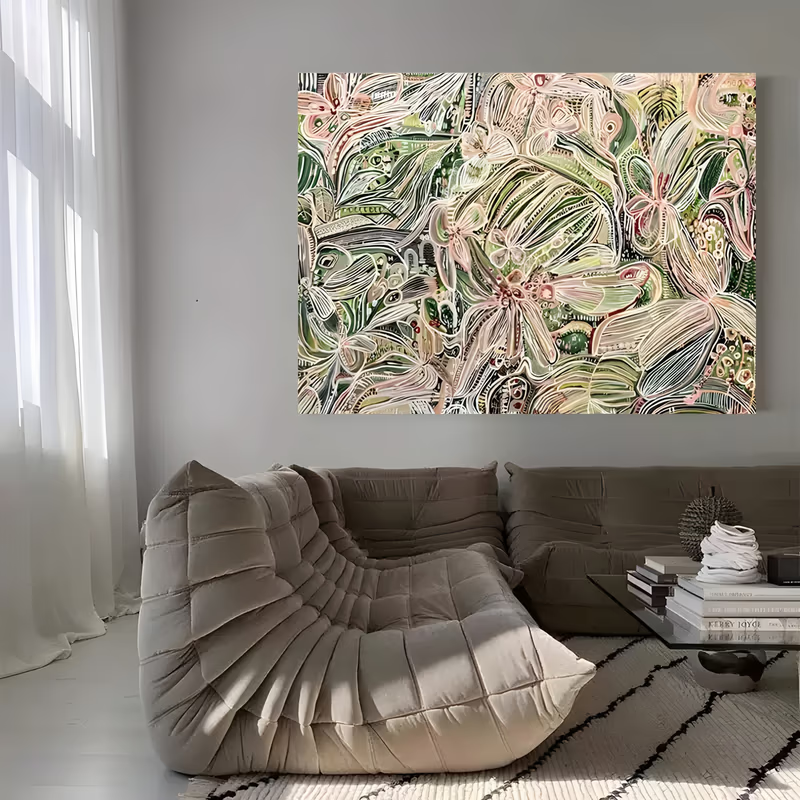
A panoramic field of poppies, daisies and pansies; an explosion of tiny magenta and yellow blossoms; rose-pink blooms curling over teal leaves on deep navy, in the spirit of Arts and Crafts pattern; ochre leaf and seed-pod collages; fine-line fronds on sage. They read as wallpaper made precious and suit dining rooms, bedrooms and restaurants.
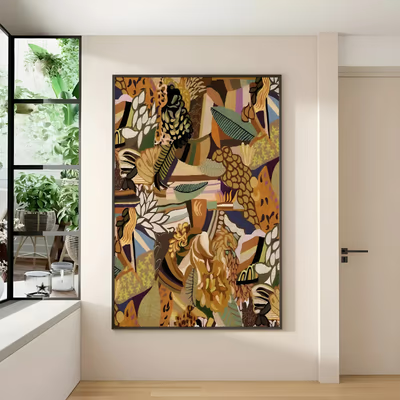
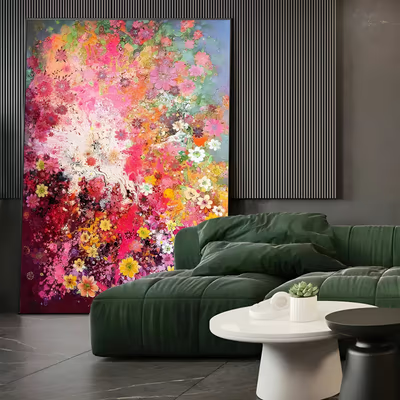
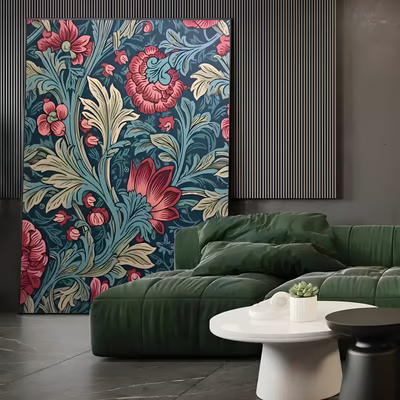
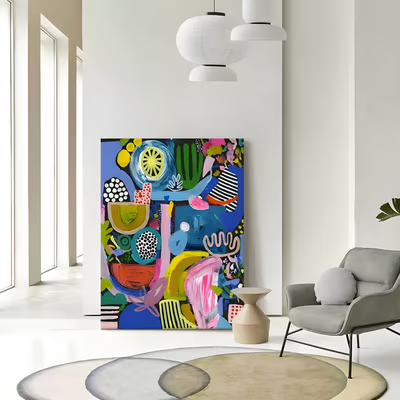
Pattern, folk scenes and graphic abstracts
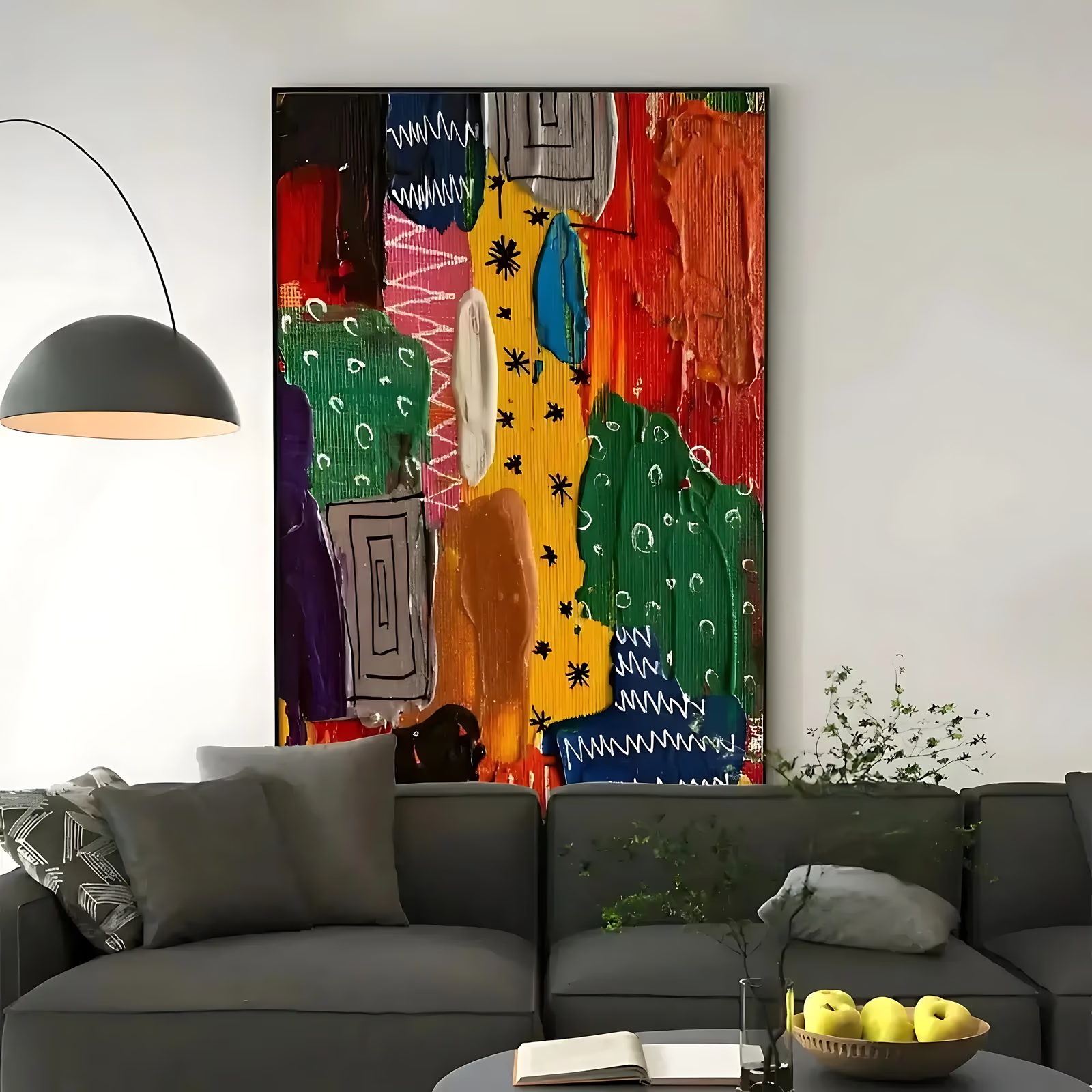
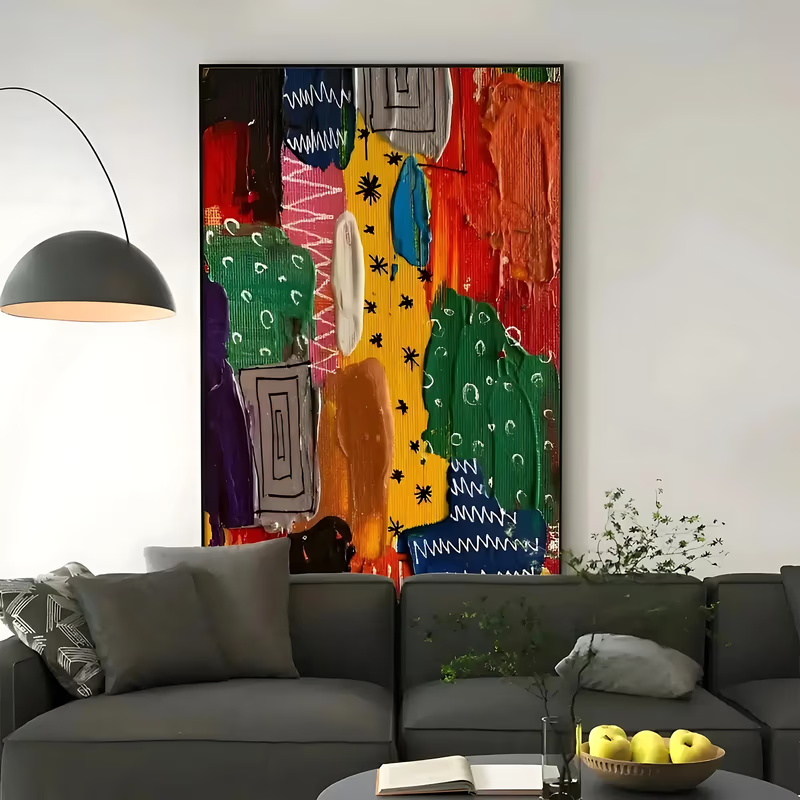
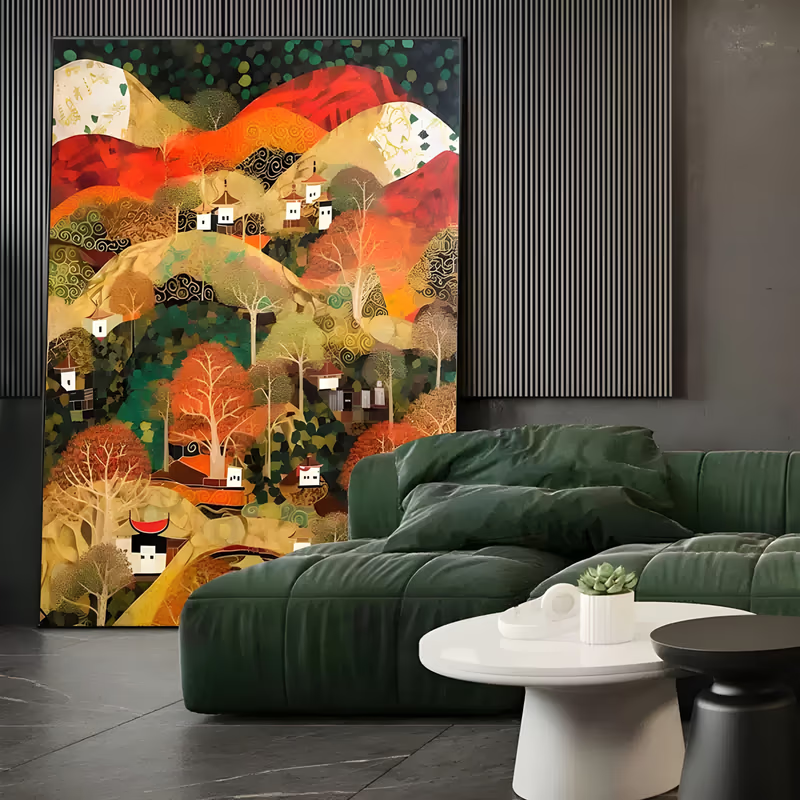
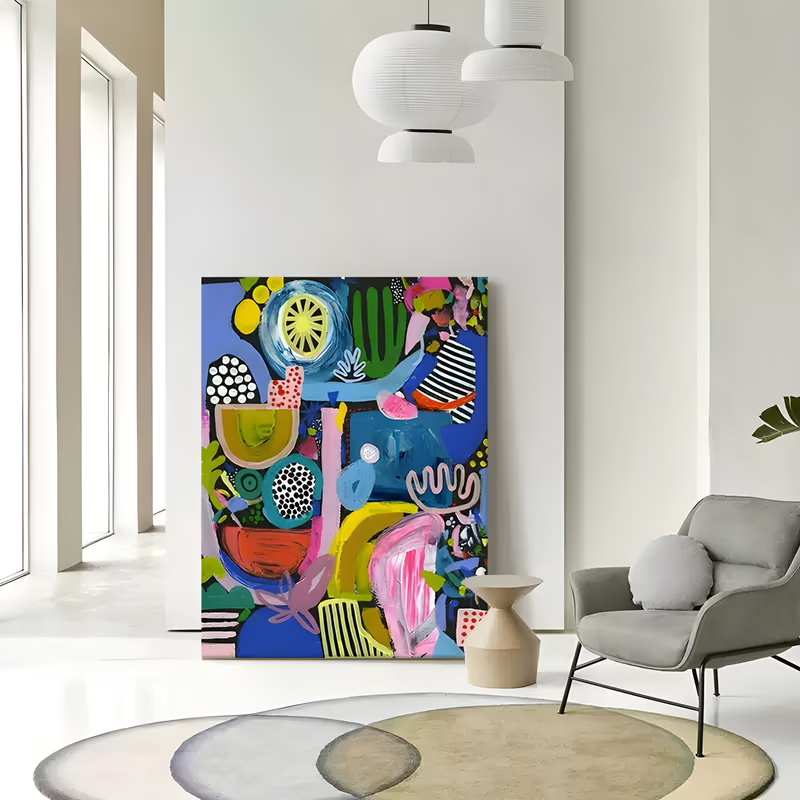
A bird's-eye city built from hundreds of red and orange blocks; thick paint slabs scratched with zigzags and stars; red-roofed houses scattered over striped hills; masks, crowns and scrawled symbols on a peach and black ground. These carry the most energy and belong in creative offices, galleries, bars and entrance halls. See also geometric paintings and folk-inspired art.
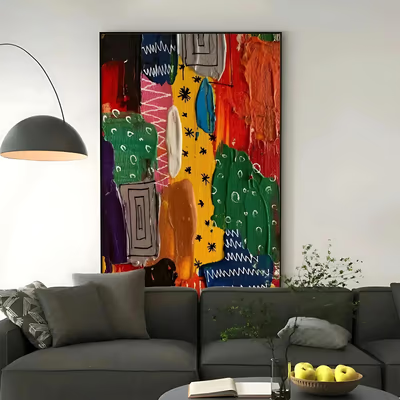
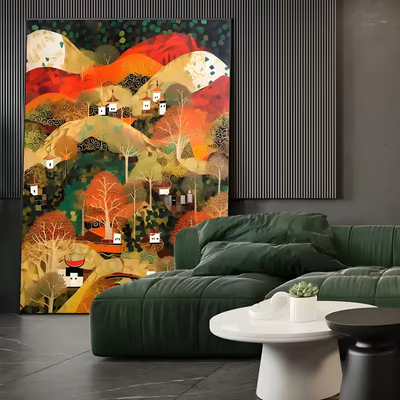
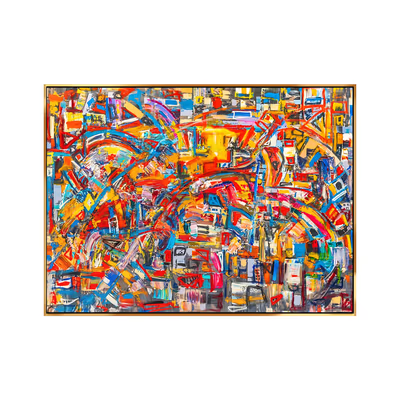
Which interiors suit maximalist wall art?
Maximalist wall art suits jewel-toned and eclectic rooms where it joins the layering, and it can also act as the single bold voice in a calm, pared-back space.
Jewel-box maximalism
Emerald velvet, deep teal walls, brass lamps and patterned rugs. A floral maximalist canvas on a dark ground fits right in and ties the colours together.
Eclectic and boho
Vintage finds, kilims, rattan and plants. Folk villages, leaf collages and pattern-built abstracts suit the handmade, collected mood.
Modern classic and Regency revival
Panelled walls, lacquer and gilt. Dense florals in a gold frame look like a contemporary answer to an old tapestry.
Arts and Crafts and cottage
Patterned chintz, painted woodwork and garden views. Curling floral patterns and flower-crowded garden scenes continue the story.
A calm room that needs one loud note
White walls, plain sofa, simple floor. Here a single maximalist canvas does all the decorating, and the quiet surroundings keep it from feeling crowded.
How do you layer maximalist art with wallpaper, rugs and fabrics?
Layer maximalist art by varying the scale of pattern, repeating a shared colour, and giving the painting a clear border so it reads as a picture rather than more wallpaper.
Vary the scale. If the wallpaper has a big, open motif, choose a painting with small, tight pattern, and the reverse. Two patterns at the same scale blur together; different scales give the eye levels to read.
Share at least one colour. Pick one hue from the painting, a teal leaf or a coral bloom, and make sure it appears in the wallpaper, the rug or a large fabric. That single link turns clashing into conversation.
Build a frame of calm. A gilded or black frame, a solid-coloured sofa beneath, or a strip of plain wall around the canvas marks where the painting ends. Against a busy wallpaper, a wide frame matters more than usual.
Edit the neighbours. On the same wall, keep shelves and smaller frames to a minimum, or arrange them at a distance so the hero canvas keeps the lead. Filter the works by colour to find the link you need: pink and red, green, teal and blue, or gold and orange.
What size should maximalist wall art be, and is one canvas enough?
One large maximalist canvas is usually enough, and bigger is better, because dense detail needs room to read from a distance.
A pattern-packed painting turns to texture when it is small and far away. On a main wall, choose a canvas that spans most of the sofa or console below it, or fills around three-quarters of an empty wall's width; in an entrance hall, a tall vertical piece facing the door works well. Put the centre of the canvas close to eye level, about 145–150 cm (57–59 in) from the floor, so the detail sits where people look.
Small rooms are not off limits. A powder room, a narrow hallway or a reading nook can take a dense painting surprisingly well, since the space is viewed up close and briefly. If you want a gallery wall instead, let one maximalist canvas be the anchor and group calmer pieces around it, sharing one frame finish so the arrangement holds together.
Where does maximalist art work in restaurants, bars and hotels?
Maximalist art earns its place in hospitality wherever a room needs a memorable identity: bar walls, restaurant banquettes, boutique lobbies and the ends of long corridors.
Guests photograph spaces that feel generous and particular, and a densely patterned canvas gives that impression at a glance. Behind a bar or along a banquette, a panoramic piece carries the pattern across the whole wall. In a lobby, a single oversized canvas sets the tone for the brand. In corridors, a dense painting at a dead end draws people along.
Browse by space: maximalist art for restaurants and dining rooms, for lobbies and entrances, for shops and creative offices. For trade programmes, see restaurant groups and bars and boutique and independent hotels.
How do you commission a maximalist painting that fits your scheme?
Send your wallpaper, fabrics or paint codes with the size you need, and the maximalist painting is recoloured and re-proportioned to suit before work starts.
Each piece is painted to order, so the palette can be shifted to pick up a specific velvet, tile or wallpaper, and the composition is redrawn rather than stretched when the format changes from vertical to panoramic. Any work in the catalogue can be made more abundant, or painted in a new colourway: see also custom and commission.
With so much detail, checking matters. You receive progress photos or video at each stage, and the next stage begins only after your approval; a final photograph is approved before dispatch. The canvas ships rolled, stretched ready to hang, or framed in gold, silver, black, white or wood. Request a quote to start.